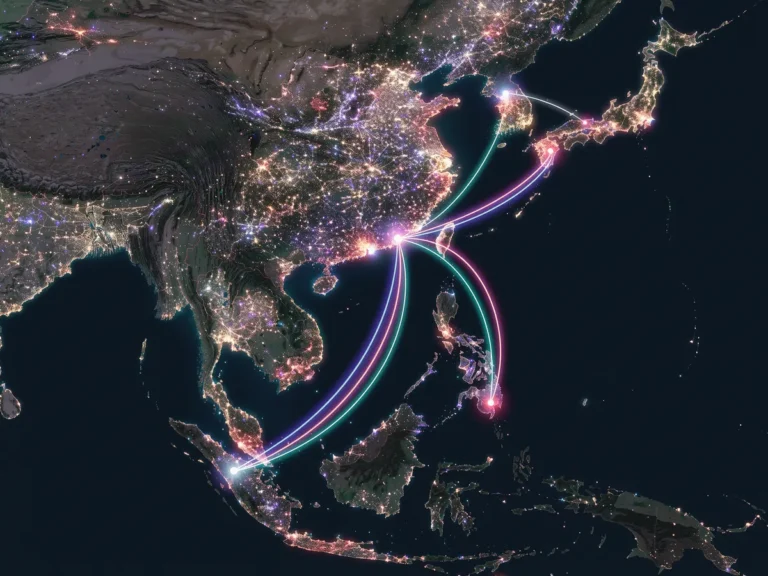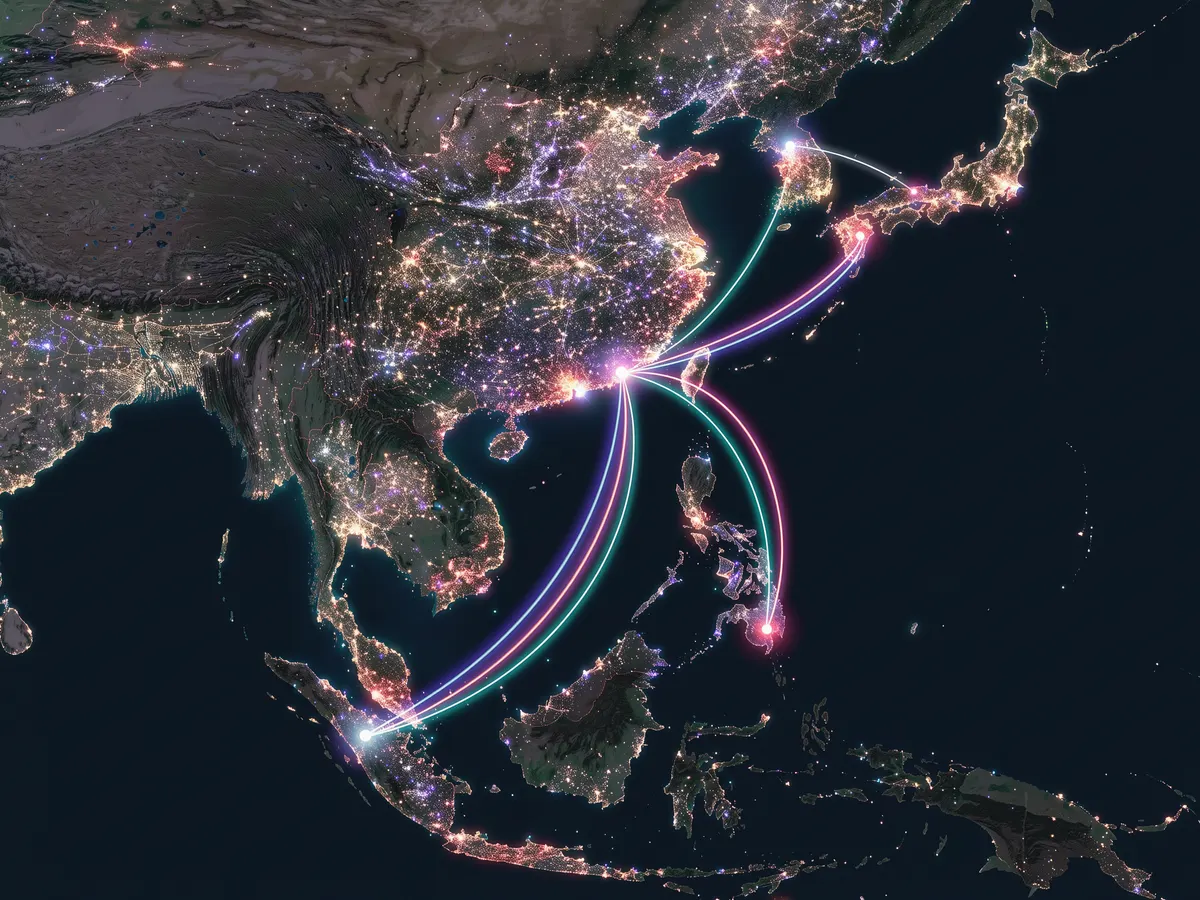
Short-haul flights into Incheon and Jeju have quietly fed South Korea’s foreigner-only casino floors for years, carrying Japanese and Chinese visitors who can be at a baccarat table two hours after leaving home. That routine is the thing now under review. A study reported by GGRAsia projects that South Korea’s casinos could lose up to US$1.72 billion in gaming spend once MGM Osaka opens, and that single number has become shorthand for a much larger story about Asian casino market trends: a region where one new integrated resort can reroute demand across four or five national markets at once.
What the study actually projects, and what the number is not
The projection is an upper bound on diverted gaming spend, not a forecast of what South Korea will definitely lose. GGRAsia’s framing is explicit about this: casinos “could lose up to” US$1.72 billion, which is the top of a modelled scenario range rather than a central estimate. Strip the words “up to” and you have changed the claim.
That distinction matters more than it sounds. A ceiling scenario assumes the most aggressive version of every input at once: MGM Osaka opening on schedule, operating at its intended scale, and capturing the maximum plausible share of players who currently travel to Korea. Weaken any one of those assumptions and the figure falls, possibly a long way. The same discipline applies to any headline built on a model, which is why it pays to read the assumptions behind a number before trading on it, much as it does when reading monthly casino gaming revenue reports.
What the study does not settle, at least not in the reported summary, is how much of Japan’s eventual casino spend will be genuinely new demand created by a domestic market opening to local residents, rather than spend pulled out of neighbouring countries. Those are two very different outcomes for Korea, and the answer will only be visible after the property trades for a year or two.
Why South Korea’s foreigner-only casinos carry the exposure
South Korea’s vulnerability comes from its licensing model: with the single exception of Kangwon Land, its casinos may legally admit only foreign passport holders. Every won of that revenue therefore depends on inbound visitors, principally from Japan, Greater China and Southeast Asia, which is exactly the pool a new Japanese resort would compete for.
Kangwon Land, the one venue Koreans may enter, is largely insulated. It serves a domestic customer who was never flying to Osaka to gamble in the first place. So the risk is concentrated, not national: the properties with the most to lose are the foreigner-only operators in Incheon, Seoul and Jeju that have built their business on short-haul Japanese and Chinese arrivals. Anyone reading the $1.72 billion as a hit to “South Korea’s casino industry” as a whole is reading it too broadly.
What MGM Osaka is, in factual terms
MGM Osaka is the integrated resort being developed by MGM Resorts International and Japanese financial group Orix on Yumeshima, a reclaimed island in Osaka Bay, under Japan’s first approved IR licence. For now it is the only one in play: Nagasaki’s integrated resort bid was officially rejected by Japan’s central government in December 2023 over uncertainty around the financing of its casino operations, leaving Osaka as the sole licensed project, with new IR bidding set to resume in May 2027. An integrated resort bundles a casino floor with hotels, convention space, retail and entertainment, with the gaming area legally capped as a small share of total floor space.
Publicly reported target opening has sat around the end of this decade, but schedules on projects of this scale move, and the operator’s own disclosures are the only reliable source on current timing, investment and room count. Treat any date you see quoted second-hand as provisional. Two structural points are firmer: Japanese residents will be able to enter, subject to an entry fee and statutory limits on visit frequency, and Osaka sits inside one of the densest affluent catchments in Asia, with Kansai International Airport on its doorstep.
How one opening relocates regional player traffic
Cross-border casino demand follows a short list of practical variables, and a new resort can move several of them at once. In rough order of weight:
- Flight time and cost, which determine whether a casino trip is a weekend or a holiday.
- Novelty, which reliably inflates visitation in a property’s first 12 to 24 months before normalising.
- Product depth, meaning table count, hotel inventory, restaurants and the non-gaming draw that justifies a longer stay.
- Host and VIP relationships, including the junket and premium-mass channels that move high-spending players wherever credit and comps are best.
- Visa friction and currency, which quietly reshape which destinations look cheap in a given year.
For a Japanese player, almost all of those shift in Osaka’s favour the day it opens: no flight, no passport, a brand-new floor. For Chinese and Southeast Asian players it is a new option in an already crowded set. The honest read is that Korea’s Japanese segment is the clearly exposed one, and its Chinese segment faces a marginal, not existential, threat.
The rest of the field: Macau, Singapore and the Philippines
Asia’s integrated resort race is not a Japan-versus-Korea story. It is five markets with different access rules chasing an overlapping customer base.
| Market | Who can play | Competitive position |
|---|---|---|
| Macau | Locals and visitors | The region’s GGR leader by a wide margin; heavily reliant on mainland Chinese demand |
| Singapore | Locals (entry levy) and visitors | Two licensed resorts, premium-mass focused, both committed to major expansions |
| Philippines | Locals and visitors | Several licensed resorts plus a large online sector; broadest price range in the region |
| South Korea | Foreigners only, except Kangwon Land | Entirely inbound-dependent; smallest exposure to domestic demand |
| Japan | Residents (entry fee, visit caps) and visitors | One IR licensed, in Osaka; Nagasaki’s bid rejected in December 2023, next bidding round from May 2027; untested, with the largest unserved domestic catchment |
Macau’s shifting market position
Macau remains the largest casino market in Asia, but its mix has changed fundamentally. Gross gaming revenue peaked in 2013 and the VIP junket model that drove that peak has been curtailed by enforcement action and by concession terms that now require operators to invest substantially in non-gaming attractions. The growth story Macau sells today is premium mass and tourism, not credit-funded high rolling, which makes it less directly comparable to a new Japanese resort than the raw revenue gap suggests.
Singapore and Southeast Asia’s resort hubs
Singapore’s two-licence duopoly has spent years optimising for premium mass rather than volume, and both resorts are mid-way through large expansions that add hotel and entertainment capacity. The Philippines competes on a different axis, with more properties, lower barriers and a regulator that has been unwinding its own operating role. Both compete with Korea for the same regional travellers, and both will compete with Osaka. A Japanese opening does not create a new fight so much as add a well-capitalised entrant to one already running.
What to watch before the headline becomes a fact
The projection becomes testable only when four things are known, and none of them are yet. First, MGM Osaka’s confirmed opening date and final scale, from the operator rather than from aggregated coverage. Second, what happens when IR bidding resumes in May 2027, since a single trading property in Osaka and a second licensed in another prefecture imply very different regional effects. Third, how Korean operators respond, whether through marketing spend, junket and host incentives, non-gaming investment, or lobbying for changes to the foreigner-only rule. Fourth, early Japanese visitation data showing the split between new domestic players and repatriated outbound ones.
MGM is a useful case study in how little is certain even for a committed operator, as its blocked Springfield casino sale showed on a smaller stage. Projects slip, approvals stall, and local politics intervene. Nagasaki is the sharper lesson: a bid that spent years in the pipeline and was rejected over financing.
For now, the sensible position is that the $1.72 billion figure is a well-publicised ceiling on a plausible scenario, useful for sizing the risk to Korea’s foreigner-only operators and close to useless as a prediction. The spend it describes belongs to real people making discretionary decisions, and anyone who gambles in any of these markets should still be setting their own deposit and session limits regardless of which flag the resort flies. Whether Osaka ends up taking Korea’s customers or simply discovering its own is the question the whole region is waiting on, and it will not be answered by a model.
About The Author