A price of 1.50 does not mean the favourite wins two games in three. It looks like it: 1 divided by 1.50 is 66.7%, and that number feels like a forecast. It isn’t. Part of that 66.7% is the bookmaker’s cut, baked into the price before anyone has kicked a ball. Miss that and every other thing you believe about soccer betting is built on a cracked foundation.
Soccer betting is staking money on an outcome inside a football match, priced as odds that convert to an estimated probability. The estimate comes from the bookmaker, it is deliberately shaded in the bookmaker’s favour, and it is never a promise about what will happen. What follows walks you through the markets you’ll meet on a Premier League or Serie A matchday, how to read and convert any price in one step, what makes lines move, how the leagues differ, and where Indian law sits on all of it.
The markets you’ll actually see on a matchday
Six markets cover most of what a top-league coupon offers. Learn these and you can read almost any football card without guessing.
Match result (1X2) and double chance
1X2 betting is a three-way market on 90 minutes plus stoppage time: home win (1), draw (X), away win (2). Extra time and penalties in a cup tie don’t count unless the market says so. Double chance folds two of those three into one bet, so “1X” wins if the home side wins or draws. You cover more ground and the price drops accordingly. Draw no bet does something similar: back a team, and if the match is drawn your stake comes back.
Over/under goals
Over under betting asks how many total goals both teams combine for, against a line such as 2.5. Over 2.5 needs three goals or more; under 2.5 needs two or fewer. The half-goal exists to remove the tie. Whole-number lines such as 2.0 do allow a push, where exactly two goals returns your stake.
Both teams to score (BTTS)
BTTS is a yes/no on whether each side scores at least once. The scoreline is irrelevant: 1-1, 3-2 and 4-1 all settle “yes”, while 3-0 and 0-0 settle “no”. It is the one popular market where you can lose your team the match and still win the bet.
Asian handicap
Asian handicap removes the draw by giving one team a goal head start or deficit. At -1, your team must win by two or more; a one-goal win settles as a push and your stake is returned. At -0.5 the handicap behaves like draw no bet on the favourite. Quarter lines such as -0.25 split your stake across two handicaps, which is why half of it can win while the other half pushes. This market confuses more new bettors than any other, and I’d leave it alone until the half-goal and whole-number versions genuinely make sense to you.
Correct score and first goalscorer
These are the long shots, and they carry the heaviest margin on the card. Correct score needs the exact final scoreline. First goalscorer needs the right player at the right moment, with most books voiding the bet if your pick doesn’t start, which is a term worth reading before you stake anything.
Reading football betting odds in three formats
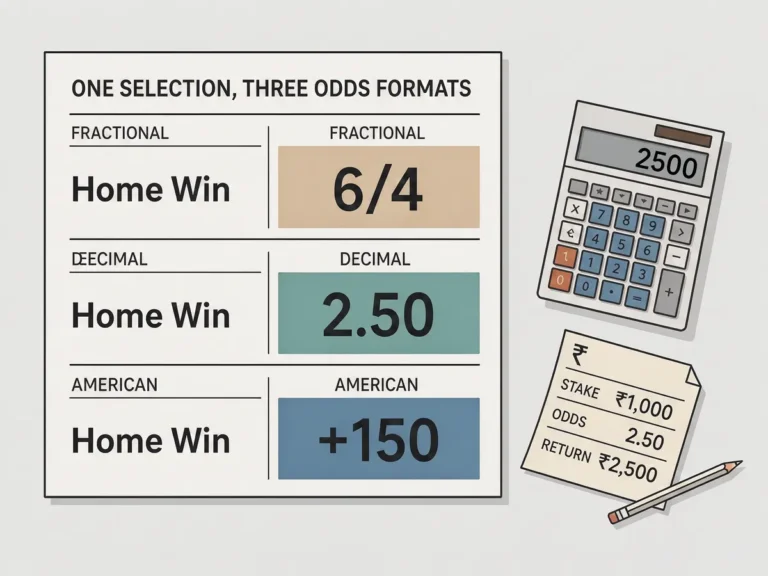
Decimal, fractional and moneyline odds express exactly the same thing in different notation. Decimal gives total return per unit staked including the stake. Fractional gives profit relative to stake. Moneyline uses a positive number for profit on 100 units and a negative number for the stake needed to win 100.
| Decimal | Fractional | Moneyline | Implied probability |
|---|---|---|---|
| 1.50 | 1/2 | -200 | 66.7% |
| 1.90 | 9/10 | -111 | 52.6% |
| 2.00 | 1/1 | +100 | 50.0% |
| 2.50 | 3/2 | +150 | 40.0% |
| 3.40 | 12/5 | +240 | 29.4% |
| 6.00 | 5/1 | +500 | 16.7% |
Two bits of arithmetic do all the work. To turn fractional into decimal, divide and add one: 3/2 becomes 1.5 + 1 = 2.50. To turn decimal into a percentage, divide one by the price: 1 ÷ 2.50 = 0.40, or 40%. That percentage is the implied probability, and it is the only version of a price you should be thinking in. Comparing 11/8 with 2.35 is awkward; comparing 42.1% with 42.6% is not.
Where the bookmaker margin hides
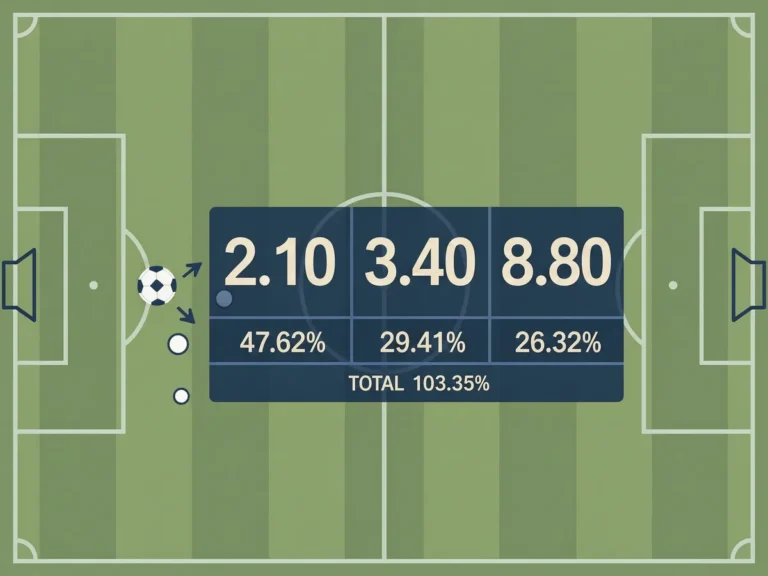
Add up the implied probabilities in any market and the total exceeds 100%. That excess is the margin, also called the overround or the vig. Take a two-way market priced 1.90 on each side. Each price implies 52.6%, the two together sum to 105.2%, and that extra 5.2% is the house’s built-in edge on a genuine coin flip.
The same logic applies to 1X2. A Serie A match priced 2.10 / 3.40 / 3.80 implies 47.6% + 29.4% + 26.3% = 103.3%, so the margin is roughly 3.3%. Main markets on big leagues carry the thinnest margins. Correct score, first goalscorer and most novelty markets carry far more, sometimes multiples of it, because fewer people check. That is the cost of getting this wrong: not one bad result, but a steady drip of paying 10% or 15% over fair value on markets that look fun and price terribly. Over hundreds of bets, the margin you accepted matters more than any single call you made.
Why soccer match odds move before kick-off
Prices move when the information behind them changes, or when the money coming in forces the book to rebalance. The usual triggers:
- Confirmed team news, especially a first-choice goalkeeper, centre-back or main striker missing
- Published lineups roughly an hour before kick-off, often the sharpest single move of the day
- Injuries and suspensions, including players carrying a yellow-card risk into a run of fixtures
- Rotation ahead of a Champions League tie or a congested festive schedule
- Weather, with heavy rain or strong wind usually pulling goal lines down
- Recent form and head-to-head patterns, which models weight far less heavily than fans do
- Heavy one-sided betting volume, which shortens one side whether or not the underlying probability changed
That last point is worth sitting with. A shortening price tells you money has arrived. It does not tell you the money was right.
How in-play betting changes during the 90 minutes
Live odds reprice continuously because the two things that matter most, the scoreline and the time remaining, are both changing. A goal moves everything at once: the match result, the over/under line, BTTS, the handicap. A red card can move prices further than a goal does, because it alters the rest of the match rather than just the current state. And as the clock runs down, under lines shorten simply because there is less time left for a goal to arrive. In-play markets also carry wider margins and bet-delay rules, which is exactly when a rushed stake is easiest to regret.
What changes between the Premier League, Serie A and the rest
League tendencies show up in where the lines are set, not in who wins. Premier League matches are typically priced around higher-tempo, transition-heavy football, so goal lines often sit at 2.5 or above and BTTS prices tend to be tighter. Serie A betting has long been associated with more tactical, lower-scoring games, and you’ll sometimes see goal lines set at 2.5 or below in fixtures that would be priced higher in England. That reputation is a tendency, not a rule, and it has softened in recent seasons.
Among the other leagues Indian fans follow, the Bundesliga has historically run goal-heavy, La Liga sits somewhere between England and Italy in tempo, and Champions League group-stage ties often produce lopsided prices because the gap in squad quality is wider than in a domestic league. Knockout legs add their own wrinkle: away goals no longer separate ties in UEFA competitions, and 90-minute markets still ignore extra time unless stated.
Where India’s law sits on soccer betting
Betting and gambling fall under the states in India, not the centre, which is why the rules differ sharply depending on where you live. The Constitution of India places “betting and gambling” in Entry 34 of List II, the State List, in the Seventh Schedule, with the colonial-era Public Gambling Act, 1867 as the baseline framework many states adapted. Some states have built licensing regimes; others have explicit prohibitions covering online wagering, with penalties attached.
Online and offshore betting has sat in an unsettled space for years, and central legislation touching online money gaming has moved more than once recently. This article is general information and not legal advice. Check the current law in your own state, and the current central position, through official government sources before you assume anything. Tax treatment is a separate question again: winnings from online gaming are taxable in India with TDS applying on net winnings, and a qualified professional is the right person to ask about your specific position.
Reading odds responsibly
A price is an estimate with a fee attached, not a forecast and not a signal. You can audit the fee by converting every market you look at into percentages and summing them, which takes seconds and tells you more than any tip ever will. What you cannot audit is the outcome. Nothing in this guide, and nothing anyone publishes, changes the fact that the margin means the house holds the long-run edge.
So decide the money before the match, not during it. Set a limit you’d shrug at losing, use deposit and loss limits if your platform offers them, and treat a losing afternoon as finished rather than as something to win back. Betting is for adults aged 18 and over. If staking money has started to feel like an obligation rather than an occasional bit of interest in a Serie A fixture, step away from it and talk to a professional or a recognised gambling-support helpline. The useful skill here is reading the number honestly, and that skill works just as well when you decide not to bet at all.
About The Author