Adding a button the player has to press does not keep a gambling machine outside gambling law. That belief held up a roughly 70,000-terminal industry in Pennsylvania for about a decade, and in October 2026 it collapsed in a single afternoon. Skill games are coin-operated terminals that look and play much like slot machines, but require some player input — a nudge, a memory step, a pattern spotted on screen — before a result pays out, and that input is what their makers argued took them out of the slot machine category. Pennsylvania’s Supreme Court disagreed. Businesses had until Tuesday, 13 October 2026 to pull the machines, and from the next morning every one still plugged in was contraband. If you want a single live example of why there is no such thing as “the” gambling rulebook, this is it.
What are skill games, exactly?
Skill games are gaming machines where the outcome depends, at least partly, on something the player does rather than purely on a random draw. The category covers everything from arcade-style fish shooting cabinets, where aim and timing genuinely change your score, to slot-styled terminals in a convenience store that look identical to a casino cabinet apart from one extra interaction.
That second type is where the money and the legal fight live. Mechanically, the slot-styled versions still generate a result electronically. What the designers add is a layer on top: in many commonly cited designs the player has to complete a follow-up task to collect, or can preview information about the upcoming game and decide whether to play it. The argument runs that a diligent player who studies the machine and performs the task correctly does better than one who mashes the button, so the outcome is not purely chance.
They’re marketed, sold and defended as amusement machines. They sit in bars, laundromats, pizza shops, VFW halls, hair salons, fraternal clubs. No casino floor, no gaming licence on the wall, often no state gaming commission involvement at all. That placement is the whole business model: a licensed slot machine has to live in a licensed venue, and a skill game, under this theory, does not.
Slot machines vs skill games: where the legal line actually sits
A slot machine’s outcome is set by a random number generator and nothing the player does after pressing spin can alter it; a skill game’s outcome is said to turn, at least in part, on player input. Everything else — licensing, tax, where the cabinet can stand, who audits the payout percentage — follows from that one distinction.
| Licensed slot machine | Skill game (as marketed) | |
|---|---|---|
| Outcome determined by | RNG, fixed at the moment of the spin | RNG plus a required player action or decision |
| Legal classification | Gambling device | Amusement device (the claim being tested) |
| Licensing | State gaming licence for operator, venue and device | Typically none; distributors lease to any business |
| Taxation | Gaming tax on revenue, often at high rates | No gaming tax; ordinary business income only |
| Typical venue | Casino, licensed route location | Bars, convenience stores, clubs, nonprofits |
| Payout oversight | Independent lab testing, regulator-audited | Largely unverified by any gaming regulator |
Read that last row twice if you’ve ever played one. On a licensed machine, the return to player is a tested, auditable number and the regulator can go back through the logs. On an unregulated terminal, you’re taking the manufacturer’s word for it. Casino operators and the American Gaming Association spent years making exactly this point, with the AGA arguing the machines were playing word games to get around the law and regulatory enforcement.
The predominance of skill test explained
The predominance test asks whether skill or chance is the dominant factor in determining the outcome — not whether skill is present at all. Almost every gambling game contains a sliver of decision-making, so a test based on “is there any skill?” would classify roulette as a puzzle. Courts therefore ask which force is doing the heavy lifting over repeated play.
In practice that turns into evidence about the machine: how much of the result is locked in before the player touches anything, whether a player who performs the skill task perfectly actually earns more than one who ignores it, and by how much. If pressing the right button at the right moment moves your return by a few percent while the RNG decides the rest, chance predominates. If the task genuinely drives the result, the machine has a case.
Here’s the part that catches people out. Some states don’t use a predominance test at all. A handful apply an “any chance” standard, under which a material element of chance makes a device gambling regardless of how much skill sits on top. Same cabinet, same software, opposite verdict, purely because of the test the legislature wrote decades ago. That’s not a loophole being exploited; it’s the actual structure of US gaming law.
Why Pennsylvania pulled the plug on 70,000 terminals
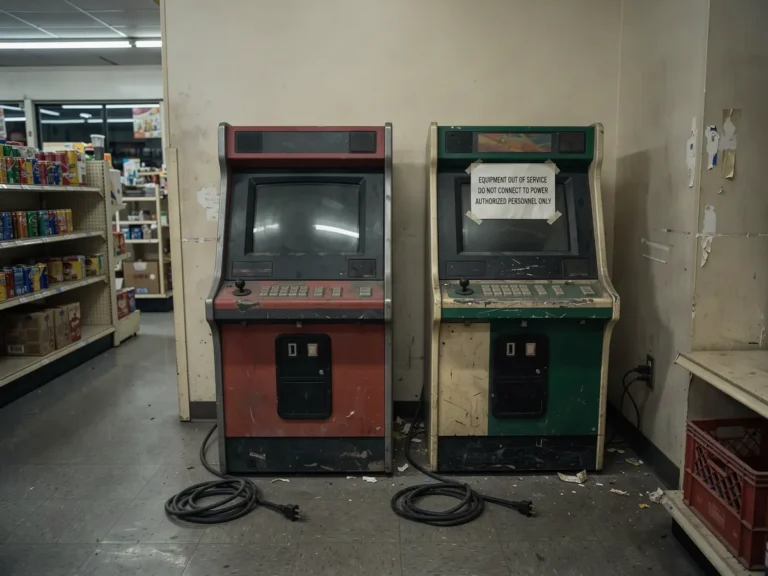
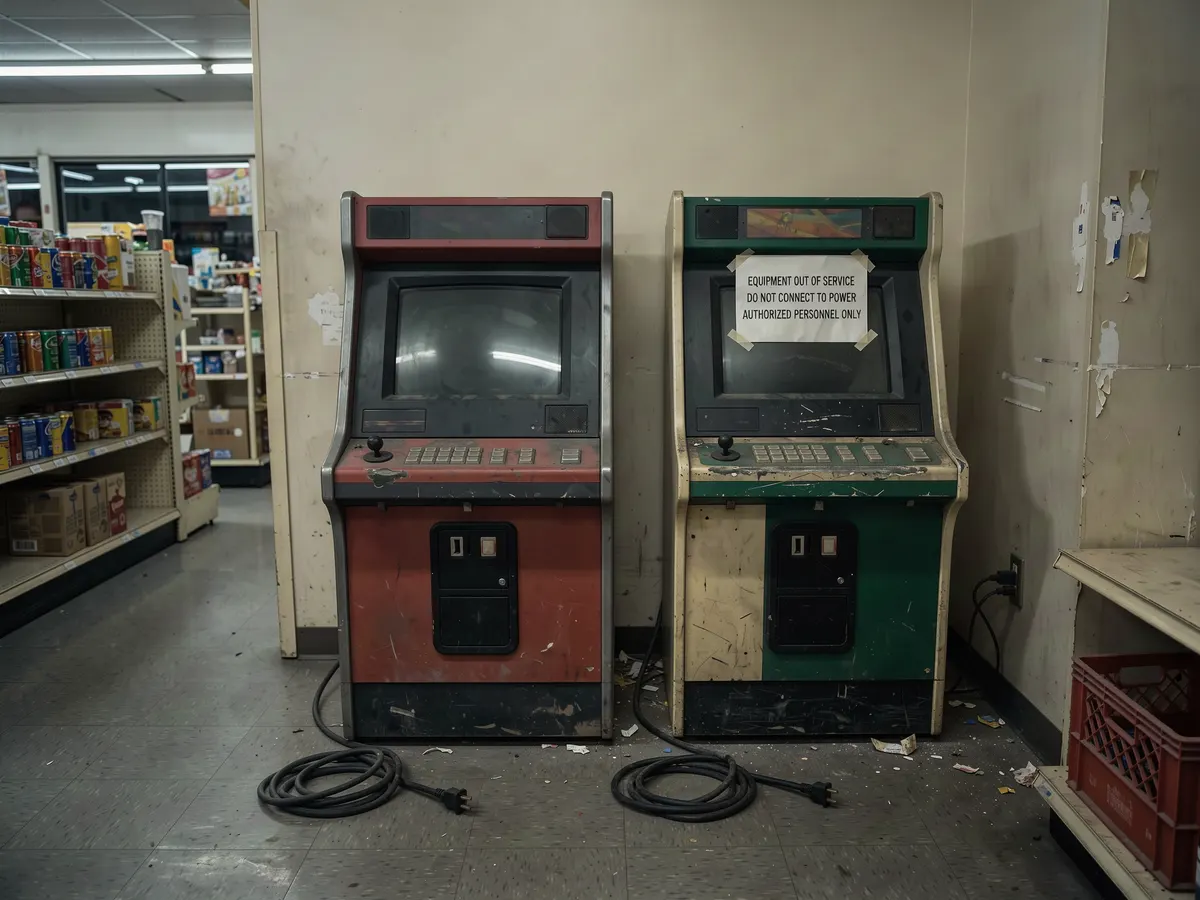
In June 2026 the Pennsylvania Supreme Court ruled that skill games are slot machines under state law, and therefore unlawful unless licensed. The court stayed enforcement of that ruling for 120 days to give lawmakers room to build a regulatory system around the machines. Lawmakers did not reach agreement. The court then denied requests to extend the deadline, and the clock ran out on 13 October 2026.
From the following morning, an estimated 70,000 terminals statewide were officially illegal, according to CDC Gaming’s reporting. The Pennsylvania State Police had warned a month earlier that any skill game still operating was subject to immediate seizure and that business owners could face criminal prosecution. So the answer to “what happens if you miss the deadline” is not a fine and a warning letter. It’s the machine on a truck and your name on a charging document.
The background matters for understanding why nobody got much sympathy. The machines ran for roughly ten years without a comprehensive statewide regulatory framework, paying no gaming tax while licensed casinos paid some of the highest slot tax rates in the country. Penn Entertainment’s Jeff Morris described the end of the industry as the close of years of widespread illegal gaming that had ignored responsible-gaming protocols and consumer protections while contributing zero tax revenue to the Commonwealth. The AGA’s Tres York framed the deadline as making it official that so-called skill games are illegal slot machines in Pennsylvania. Two of the loudest voices against skill games were, in other words, the taxed and licensed competition — which is also a fair description of how gambling tax burdens shape operator behaviour generally.
The cost landed hardest on the middle of the supply chain. Joe Rocca, who owns Rite Touch Distribution in Pittsburgh, told CDC Gaming that 99% of his business was leasing terminals to customers or selling them to distributors, who in turn leased to small businesses and nonprofits. The 1% outside Pennsylvania wasn’t enough to keep the company alive. He expected to be sitting on 1,000 terminals once the removals finished, and said the equipment would end up in landfills or on the used market. Notably, Rocca agreed the terminals should have been regulated — just not left in hair salons.
That’s the position the standard advice led people to. Thousands of venue owners were told, consistently and by people with real legal opinions behind them, that these cabinets were amusement machines. They signed leases, took the revenue share, built it into their margins. None of that survived one appellate ruling. Pace-O-Matic, the best-known maker in the state, said it was complying with the law and that its message to operators and locations had been to follow the law, rely on accurate information and make sure games were not available for play.
Why the same machine is legal in one state and seized in the next
There is no federal definition of a “skill game,” so the classification is made state by state, under statutes written at different times for different reasons. Congress has never set a uniform line between a game of skill and a game of chance for these devices, which leaves fifty separate answers that can each change by statute, by regulator guidance, or by a court ruling like Pennsylvania’s.
Three broad paths exist. Some states have legalised and taxed route-based terminals in non-casino venues, bringing them under a gaming commission with licensed operators and audited machines. Some treat them as illegal gambling devices and enforce against them. And some sit in the gray market: no statute clearly covering the devices, no court ruling resolving it, so machines proliferate until someone sues. Pennsylvania was in the third category for about a decade and has now moved, abruptly, into the second.
Enforcement timing is its own variable. A machine can be technically illegal for years while prosecutors deprioritise it, then become a seizure target the week a ruling lands. Don’t take the absence of raids as proof of legality, and verify any specific state’s current position with that state’s own regulator rather than with a distributor’s sales deck.
What venue owners and players should take from this
Before installing or keeping a skill game, confirm the device’s current legal status with the state gaming regulator or attorney general’s office, in writing, and recheck it when courts or legislatures move. A manufacturer’s legal opinion is not a licence, and it is not a defence. The Pennsylvania experience shows how little warning you get: a June ruling, a 120-day stay, a denied extension, and then immediate seizure powers.
For players, the practical point is narrower but worth knowing. An unregulated terminal does not carry the oversight a licensed casino slot does. Nobody independent has verified its return to player, there is no regulator to complain to about a disputed payout, and the responsible-gaming tools you’d find in a licensed environment — deposit limits, self-exclusion, signage — frequently aren’t there at all. If you want to understand what oversight actually buys you, start with what a gambling licence certifies and how to verify it. And treat any gaming machine, licensed or not, as paid entertainment with a built-in house advantage rather than a way to make money; if the spend stops feeling optional, state and national helplines and self-exclusion schemes exist for exactly that.
What to watch from here
Pennsylvania settled its own question and nothing else. Other legislatures are watching the same two numbers the Commonwealth was arguing about — tax revenue forgone and consumer protection absent — and could land either way, legalising and taxing the terminals under a commission or ordering removals with their own deadlines. The genuinely unsettled part is whether a regulated skill-game category emerges as a real licensing tier in more states, or whether the whole thing gets folded back into slot machine law and disappears. Pennsylvania’s lawmakers had 120 days to answer that and couldn’t.
What’s left for anyone with money in these machines is unglamorous: check the current guidance from your own state’s regulator, check it again after any appellate decision, and don’t treat an article, a sales pitch or a decade of quiet operation as legal advice.
About The Author