How much of what you have read about sports betting and mental health is actually supported by the data, and how much is a headline stretching a correlation into a cause? The distinction matters, because the honest version of the evidence still changes how a sensible person should approach a betting app.
What the research on sports betting and mental health actually found
A public-health study from the Johns Hopkins Bloomberg School of Public Health reported that the legalisation of online sports betting is associated with higher rates of mental-health treatment, not proven to cause mental illness. The researchers tracked treatment-seeking across jurisdictions after legal online wagering arrived. Association is what the design can establish; causation is not.
That distinction is not a technicality. A rise in people entering treatment can mean more people are being harmed. It can also mean more people are finally asking for help, because gambling harm got talked about publicly at the same moment the apps launched. Both readings fit the same numbers, and a careful reader should hold both. Before quoting any specific percentage from this work, go to the Johns Hopkins Bloomberg School of Public Health write-up and the published paper behind it, and read the effect sizes and limitations yourself.
The second piece of evidence is different in kind. ProPublica reporter Jake Pearson deliberately bet like a problem gambler on DraftKings and FanDuel for ten weeks, running roughly $22,000 through the accounts. Rather than being flagged or slowed down, he was given VIP treatment on DraftKings. That is one journalist’s documented experiment, not a controlled study, and it should be weighed as such. But it tells you something a population statistic cannot: how the product responds when a customer starts behaving like someone in trouble.
So here is the claim the evidence supports, and nothing wider. Online sports betting is linked to measurably more mental-health treatment, and at least some operators’ systems reward escalating losses instead of interrupting them. Anyone who tells you the research proves betting apps cause depression is overreaching. Anyone who tells you the risk is purely a matter of individual willpower is ignoring the design.
Why an app in your pocket changes the risk arithmetic
Online sports betting safety is harder than retail betting safety because the friction that used to limit losses is gone. Walking to a shop, carrying cash and waiting for a result all imposed natural pauses. A phone removes every one of them, which is the single clearest structural difference between the two formats.
Consider what that removal actually does. A bettor who once placed two wagers a weekend can now place forty in an afternoon. Each individual bet may be small. The cumulative exposure, and the number of decisions made while emotionally activated, is an order of magnitude larger.
In-play betting and the speed problem
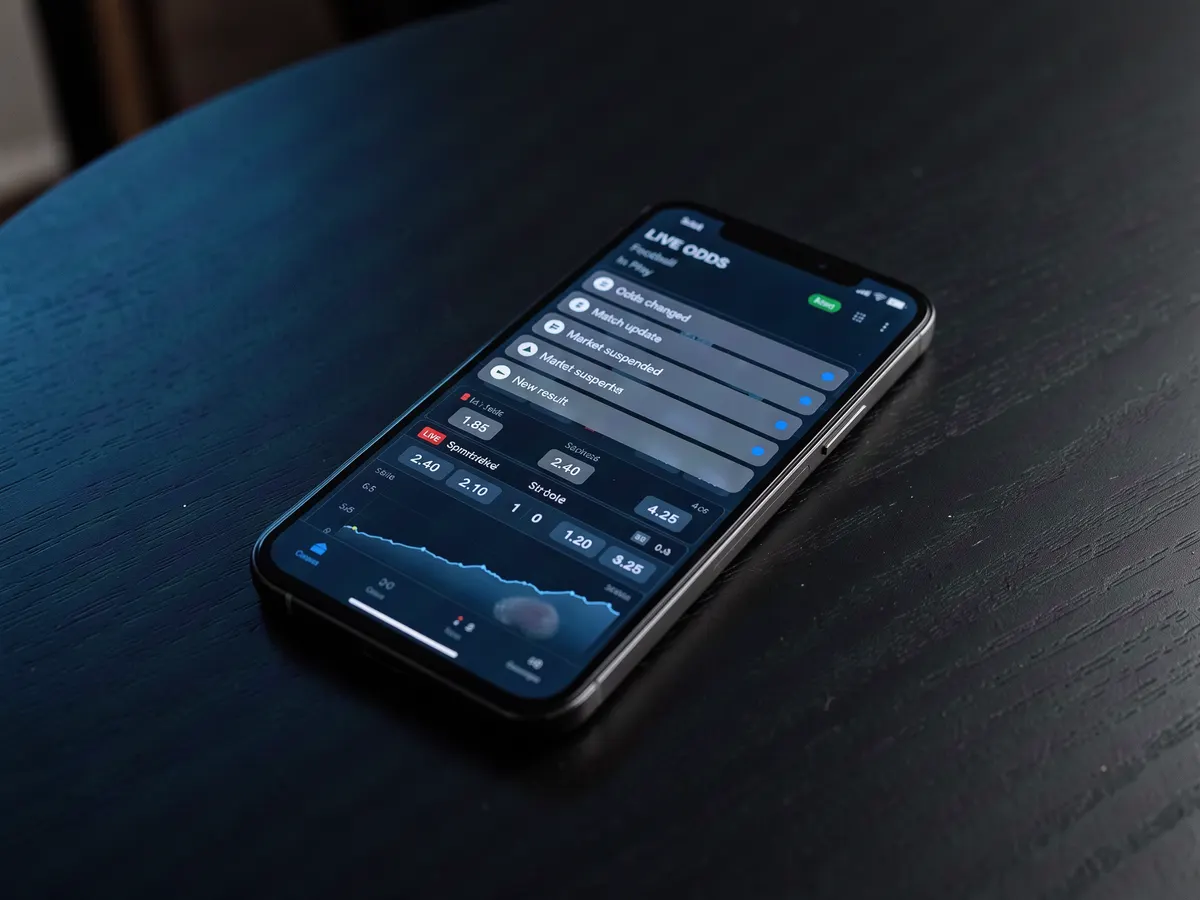
In-play betting lets you wager on events inside a live match: the next wicket, the next point, the next over. The window for each decision can be seconds long, which is too short for the kind of thinking that checks a bet against a budget. Fast, repeated, emotionally charged decisions are the pattern most associated with gambling harm across formats, which is why in-play markets deserve more caution than a pre-match bet placed on Friday for Sunday’s game.
There is also a persistent misreading of in-play odds worth naming. Live prices move because the bookmaker’s model updates, not because a value gap has opened for you. The margin built into those prices does not disappear when the match is in progress.
Notifications, promos and the VIP pipeline
Push notifications are a retention tool, and they are aimed at the moments you are most likely to bet: match start, a close scoreline, the minute after a loss. Add instant re-deposit flows, one-tap bet repeats and bonus credits timed to arrive after a losing run, and the product is nudging in one direction only.
The ProPublica experiment is the useful illustration here. The heaviest, most erratic betting pattern did not trigger a brake; it triggered account perks. If you are relying on your sportsbook to notice when your behaviour changes, that is the assumption to re-examine. Operators earn revenue from volume. Treat their duty-of-care features as a floor you can use, not a safety net you can lean on.
Problem gambling signs worth catching early
The warning signs of problem gambling are behavioural and usually visible months before money becomes a crisis. These are the specific ones to watch for, in yourself or someone close to you:
- Increasing stakes to recover losses, often on markets you do not normally bet (chasing).
- Betting money set aside for rent, fees, EMIs or groceries.
- Deleting bet history, hiding the app behind a folder or lying about how much was staked.
- Borrowing from friends, family, a credit card or an app-based loan to fund a bet.
- Restlessness or irritability on days without betting, or when a limit blocks a deposit.
- Opening a second account after hitting a self-imposed cap on the first.
- Checking live scores compulsively at work, during class or overnight, with sleep slipping.
- Letting responsibilities drift: missed deadlines, skipped commitments, withdrawn from people.
- Relief rather than disappointment when a bet loses and the cycle pauses.
Is online sports betting linked to addiction? Gambling disorder is a recognised clinical condition, and the behaviours above are how it typically begins rather than how it ends. One or two of these in a stressful week is not a diagnosis. A cluster of them persisting across months is a reason to talk to a professional, not to resolve privately.
Responsible gambling tools you can switch on today
Responsible gambling tools work best set in advance, while you are calm, and set at a level that will be inconvenient later. Deposit limits, loss limits, time limits, reality checks and self-exclusion all exist on most licensed platforms. None of them removes the house edge, and none makes betting safe.
| Tool | What it does | Where it falls short |
|---|---|---|
| Deposit limit | Caps money moved in per day, week or month | Increases often take effect after a waiting period, decreases usually apply at once; check which |
| Loss limit | Caps net losses over a set period | Not offered by every operator; does nothing about a second account elsewhere |
| Session or time limit | Ends or warns at a chosen duration | Easy to dismiss and resume unless paired with a deposit cap |
| Reality check | Periodic pop-up showing time and spend | Loses effect once it becomes familiar |
| Cool-off | Short account freeze, often days to weeks | Reopens automatically when the period ends |
| Self-exclusion | Blocks access for months or years | Usually per operator; covers only the sites you apply to |
Setting a budget that survives a bad weekend
Decide the amount before the fixture list, treat it as the price of entertainment already spent, and never top it up mid-event. A workable rule: if you would be annoyed but unaffected by losing the entire sum, it is in range; if losing it would change a payment you have to make, it is not. Keep betting funds in a separate account from salary and bills so the limit is physical rather than mental.
How to self-exclude from a betting app
- Open account settings and look for responsible gaming, safer gambling or account limits.
- Choose self-exclusion or cool-off, and pick the longest period you are willing to commit to.
- If you cannot find it, message support in writing and ask for self-exclusion explicitly; a licensed operator must action it and should also stop marketing to you.
- Repeat on every account you hold, because exclusion rarely transfers between operators.
- Remove the apps, unsubscribe from promotional email and SMS, and block payment to gambling merchants through your bank or UPI app where that option exists.
- Tell one person. Self-exclusion that nobody else knows about is the easiest kind to undo.
Note the legal frame too. Betting is for adults only, and India’s rules on online money gaming are restrictive and differ by state, with central legislation tightening the position further. Check what applies where you live before depositing anything.
Where to get support in India
Free, confidential mental-health and counselling support exists in India and does not require a gambling-specific service to be useful. Tele-MANAS, the national tele-mental health programme run under the Ministry of Health and Family Welfare, offers round-the-clock counselling across states and languages. NIMHANS in Bengaluru runs clinical services for addictive behaviours, including technology and behavioural addictions. iCall, the psychosocial helpline operated by TISS Mumbai, and the Vandrevala Foundation helpline both provide free counselling by phone and email.
Contact numbers and operating hours change, so look up the current details on each organisation’s official website rather than relying on a number copied from a forum. Gamblers Anonymous holds peer-support meetings in several Indian cities; check the organisation’s own site for the current meeting list. If a family member’s betting is the problem, these services will speak to you as well, not only to the person betting.
If there is any thought of self-harm, treat it as a medical emergency and use the national emergency and crisis lines immediately rather than a gambling helpline.
Betting with the risk in view
The sports betting risks that matter most are not the ones on the odds board. They are the ones that accumulate quietly: a limit never set, a chase that becomes routine, a loan taken to cover a shortfall nobody has been told about. The research cannot yet tell you how much of the rise in treatment is new harm and how much is harm finally surfacing, and anyone claiming otherwise is reading more into the data than it holds.
What the evidence does justify is a lower threshold for caution than the industry’s marketing implies, and a working assumption that the app will not intervene on your behalf. Set the limits first. Re-read the warning signs list in a month and check it against your own last four weeks, honestly. If something on it fits, the tools above are the starting point, and a counsellor is a better second step than another weekend of trying to get level.
About The Author