What a sportsbook trading desk actually does
A sportsbook trading desk prices markets, manages the money that comes in against those prices, and protects the operator’s margin while the event plays out. That is sportsbook trading explained in one sentence, and it is also where most explanations stop being accurate, because “protecting the margin” is not the same as “making sure both sides are backed equally”, which is what you will read almost everywhere.
The news peg for this piece is a hire. G3 Newswire reports that Pythia Sports has appointed Ben Hutton as Head of Trading, after two decades leading international racing at Entain and the businesses that became Entain: he joined Gala Coral Group in August 2005 and stayed through Ladbrokes Coral and GVC. At Pythia he takes responsibility for trading margins, how the racing product is presented to customers, and the tools the trading team uses. Three things, and they are a fair summary of what any trading function owns.
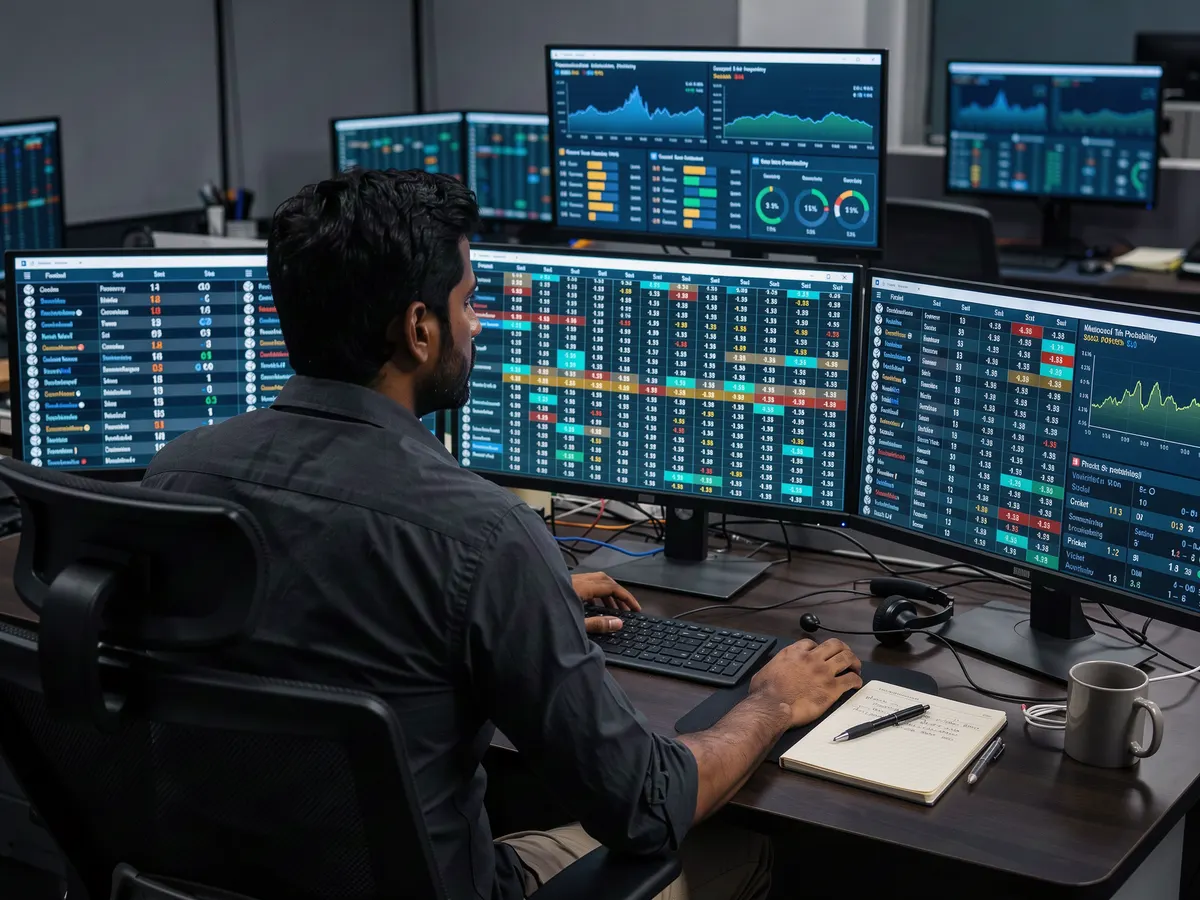
Odds compilers, traders and risk analysts: who does what
On a desk of any size the work splits into three roles that often overlap in practice.
- The odds compiler builds the first price, usually from a pricing model plus sport-specific judgement.
- The trader watches that price once it is live, adjusts it, and decides what to accept and at what size.
- The risk or quant analyst models exposure across the whole book, tests the pricing model against results, and flags where liability is concentrating.
At a small operator one person wears all three hats on a quiet Tuesday. At a large one, cricket, football and racing each have their own traders, with quants behind them and a head of trading, exactly the role Hutton is stepping into, owning the margin number at the top.
How odds are set before anyone has bet
Opening odds come from a pricing model that converts data into a probability for every outcome, which is then converted into odds and loaded with margin. No bets are needed to produce that first number, and no bets have influenced it.
From raw data to a published price
The inputs depend on the sport, but the shape is consistent. Historical results give a baseline strength rating for each team or player. Recent form, squad availability, venue, surface or pitch conditions, travel and rest adjust it. For racing, the form book, going, distance, weight and trainer or jockey data do similar work. Models output a probability: a team has, say, a 61% chance of winning, and that becomes a fair price of roughly 1.64 in decimal terms before any margin is added.
Compilers also look sideways. What other books, and particularly the exchanges, are showing is a market consensus, and a price that sits far away from the consensus is a price that gets attacked within seconds. Nobody publishes in a vacuum.
Why the opening number is a draft, not a verdict
The opening price is the desk’s best estimate at the moment of publication with the least information it will ever have. Team news is not out. Pitch reports are not out. Nobody has bet, so the desk has no read on where the market disagrees with it. Openers on obscure markets often go up at lower limits for exactly this reason: the operator is partly using early bets as information. Treat the opener as a first draft that the next few days will edit.
The margin inside every single price
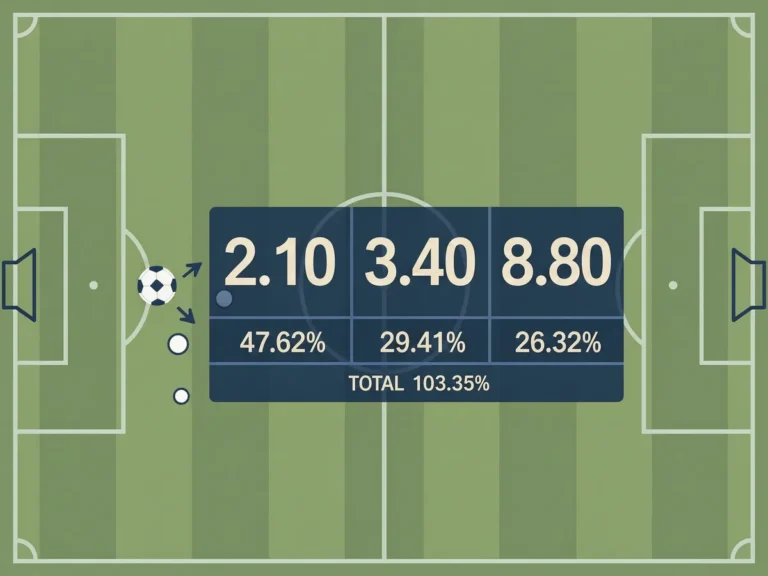
The overround, also called the vig or juice, is the margin a bookmaker builds into a market by pricing every outcome slightly shorter than its true probability. Convert each price to an implied probability, add them up, and the total comes to more than 100%. That excess is the house edge on the market, and it is there before anyone wins or loses a bet.
A two-outcome example makes it concrete. A genuine coin flip is 50/50, so the fair price on each side is 2.00, and 1 ÷ 2.00 gives 50% each, summing to exactly 100%. Price both sides at 1.91 instead and the arithmetic changes.
| Market | Decimal odds per side | Implied probability per side | Total |
|---|---|---|---|
| Fair, no margin | 2.00 | 50.00% | 100.00% |
| Priced with margin | 1.91 | about 52.36% | approximately 104.71% |
That 4.71% is the overround on an illustrative two-way market. Real margins vary enormously by sport, market and operator: headline football or cricket match-winner markets are usually tight, while obscure props, long-list outright markets and multi-runner racing books carry far more. If you are new to converting prices, our guide to decimal, fractional and moneyline odds covers the arithmetic in detail.
One honest implication: you are not beaten by a market, you are beaten by the margin. A bettor who picks winners at exactly the rate the prices imply loses money steadily, because the prices imply a little more than the truth.
Why lines move, and the explanation that gets overstated
Lines move for two reasons: the desk’s estimate of the true probability has changed, or the desk’s exposure has changed. Most popular explanations collapse both into one story, that sportsbooks shift prices to get equal money on each side and collect the vig risk-free. That story is defensible. It is just more confident than the evidence supports.
Here is the case for it. A perfectly balanced book does lock in the overround regardless of result, and desks genuinely do move prices to pull money towards the quiet side when liability gets lopsided. On high-liquidity markets with heavy two-way action, balancing is real and routine.
Here is the case against treating it as the whole explanation. Balanced books are rare in practice. Public money concentrates on favourites and on popular teams, so a desk that chased balance on every market would be pricing to sentiment rather than to probability. Most desks instead price to their own opinion, accept an unbalanced position when they think they are right, and reserve aggressive balancing for when exposure threatens the limits risk management has set. I lean to this second reading, because it is the only one that explains why books move hard on a small bet from a known sharp account and barely flinch at a large one from a recreational account. Balance would treat both as the same money. Opinion-led pricing does not.
When money moves a price
Volume alone is not the trigger. Volume from accounts with a demonstrated record of beating closing prices is. When that money arrives, the desk reads it as information that its own model is wrong and re-prices, often before liability is anywhere near a cap. Recreational volume on the other side may be absorbed without a flicker, because the desk is happy to hold that position.
When news moves a price
Confirmed team news is the cleanest re-price in betting. A star batter ruled out, a goalkeeper missing at the toss of the lineup sheet, a non-runner withdrawn, rain forecast for a chase: each changes the modelled probability, so the price changes with it. Desks routinely suspend the market for the seconds it takes to re-run the numbers, which is why you sometimes see a market grey out before a move rather than after one. In-play trading is the same job compressed: every ball, point or goal feeds a new probability, mostly automated, with a human watching for the cases the model handles badly.
Limits, liability caps and suspended markets
Bet limits cap how much a sportsbook will accept on a single selection or account, and liability caps limit total exposure to one outcome. Both exist because the operator’s edge is thin and statistical, so a single oversized bet on a mispriced market can erase the margin earned across hundreds of others.
Limits scale with confidence. A Premier League match-winner market carries high limits because the price is tested by huge liquidity and the desk trusts it. A fourth-tier total or a niche prop carries low limits because the model is thinner there. Suspension works the same way: markets are pulled during a goal, a wicket, a video review, a withdrawal, or when a feed drops, because pricing without current information is how books get picked off.
There is a fair criticism inside this. Accounts that consistently beat closing prices often get their limits cut to very little, which operators frame as risk management and winning bettors experience as being shown the door. Both descriptions are accurate. Knowing it happens is better than discovering it after you have built a bankroll plan that assumes stable stake sizes.
What a Head of Trading hire signals, and what it does not
Note what Pythia Sports is: a supplier of pricing, trading and risk management services for horse and greyhound racing, not a sportsbook taking your bet. So this appointment is investment in the infrastructure behind prices rather than in a betting brand. Hutton’s remit covers trading margins, product presentation and the trading team’s tools, and G3 Newswire notes he has recently been building AI-based trading tools and models, an interest he brings to the role. Adrien Tillier, MD and CTO at Pythia Sports, framed the hire around bringing bookmaker-side experience into how the company develops pricing, risk and product services.
One hire is one data point, not a trend, and nothing in the report quantifies spending across the industry. What it does suggest is that pricing accuracy is being treated as a specialist discipline worth paying senior money for, and that model-driven tooling is spreading through the back end of betting. AI is turning up on the customer-facing side too, which is worth understanding separately if you want to know how operators use AI to target betting ads”>how operators use AI to target betting ads. For a bettor, the practical reading is unglamorous: prices on racing and other model-heavy markets are likely to get sharper, not softer.
Reading line moves without kidding yourself
Understanding betting line management changes how you interpret a move, and it does not hand you an edge. A shortening price usually means informed money or confirmed news has arrived, which is a reason to check what you missed, not a signal to follow. A market that suspends and reopens longer has told you the desk’s estimate changed, nothing more. The overround is still sitting inside whatever number you take.
What is genuinely unsettled is how much of any specific move is opinion and how much is exposure, because operators do not publish their books and nobody outside the desk can separate the two with confidence. Anyone who tells you they can read that split from the price alone is guessing.
So decide what you want from this knowledge. If it is better calibration, knowing where margins are thin and where limits are low tells you which markets are seriously priced and which are an afterthought. If it is a way around the margin, there isn’t one: every price carries a built-in edge for the house, which is why staking should be set against money you can afford to lose. Set deposit and loss limits before you bet rather than after a bad week, and use the operator’s cool-off and self-exclusion tools if betting stops feeling like a choice.
About The Author