A casino content partnership is a business-to-business distribution deal: one company’s games get plugged into another company’s platform. That is the whole of it. When ICONIC21 announced in October 2026 that it had signed with the bespoke iGaming platform provider Advabet, better known as Adwa, nothing changed for a single player that day. What changes later, gradually, is the online casino game portfolio you see in the lobby: more studio logos, more filters, a few hundred more tiles. Whether that is an improvement depends entirely on things the press release does not mention.
What the ICONIC21 and Adwa deal actually covers
ICONIC21 is the content supplier in this arrangement and Adwa is the platform taking that content to market. The agreement spans slots, virtual games and live casino products, with an initial rollout across Adwa’s own B2C brands before it widens to Adwa’s broader B2B ecosystem. Named content includes flagship titles from Gravity Games and the virtual game iDealer Blackjack.
That direction of travel matters, and headlines routinely blur it. “Operator expands portfolio” and “studio expands reach” describe the same contract from opposite ends, and a reader who assumes ICONIC21 is the casino they will be depositing into has already misread the story. Alina Mihaela Popa, chief commercial officer at ICONIC21, pointed to Adwa’s flexibility and tailored casino solutions as the reason for the fit; Igor Drobaha, head of casino at Adwa, framed the content as added depth to the platform’s entertainment offering. Both statements are about supply chains. Neither is a claim about your experience.
Myth: an announcement means the games are live for you
A signed deal is a promise of integration, not a finished one. The ICONIC21 rollout starts with Adwa’s own consumer brands and only then reaches the operators that license Adwa’s platform, which means the same partnership arrives at different sites weeks or months apart, and sometimes partially. A casino running Adwa’s platform in one market may get the slots and not the live tables, or get them later because local certification for that jurisdiction has not cleared.
This is ordinary. It is also why a lobby that lists a studio in its “providers” filter with three games behind it is not lying to you, just early.
How the games get from a studio to your lobby
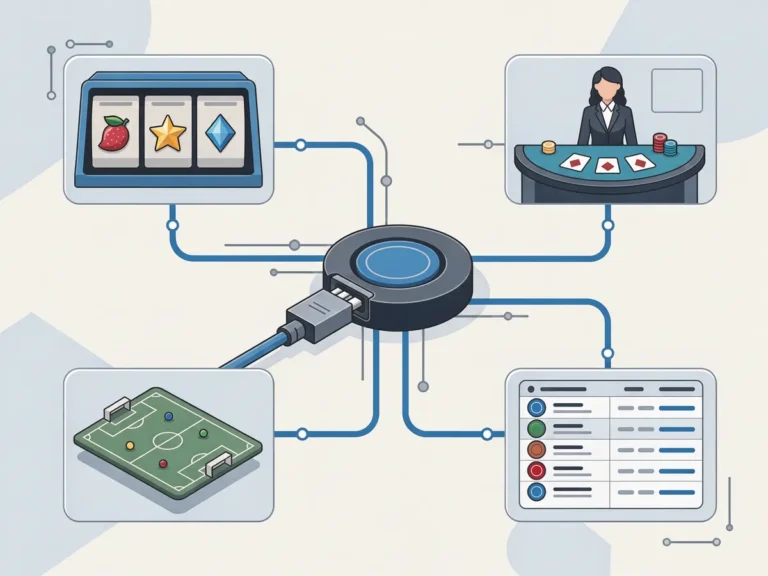
Most games reach you through an aggregator or a platform API rather than a direct one-to-one integration. The studio builds the game and hosts it; the platform exposes it through a single technical connection so an operator can switch on dozens of studios without engineering each one separately. Your bet goes to the operator’s wallet, the round is resolved on the studio’s game server, and the result comes back through that same pipe.
The practical effect for players is range rather than volume. A deal like this adds whole categories at once: different mechanics, different volatility profiles, different theoretical RTP bands, live tables from a supplier you had not seen before. That is genuinely worth something if you have been bored by one studio’s house style. It is worth nothing at all if the games are reskins of each other, which happens more often than the industry admits.
Four checks before you trust a bigger game library
Check four things, in this order: the operator’s licence and jurisdiction, independent RNG certification of the games, whether individual games disclose their RTP and paytables, and whether the studios behind the new tiles are established names or unidentifiable shells. The first one decides whether you get paid. The other three decide whether the games are worth playing.
The operator’s licence, and why it outranks everything else
Scroll to the footer. A licensed operator states the licensing authority, the licence number and usually the name of the legal entity holding it. Copy that number into the regulator’s public register and confirm it matches the domain you are on, the status is active, and the entity name is the same one in the terms and conditions. Regulators in jurisdictions such as Malta, the UK, Gibraltar and Curaçao all publish searchable lists; a footer logo that links nowhere, or links only to a picture of itself, is the oldest tell there is.
Here is where the standard advice stops working. Plenty of guides tell you to look for certified games and well-known studios as a proxy for safety. There is something to that reading: major studios do vet who distributes their content, and a lobby full of recognisable suppliers suggests the operator passed somebody’s commercial due diligence. But a certified game running on an unlicensed site is a fair game attached to a business with no obligation to honour your withdrawal. Certification covers the maths. The licence covers the money. If you only have time for one check, make it the licence.
RNG certification and who issues it
An RNG, or random number generator, is the algorithm that decides each round’s outcome independently of the last one. Independent testing laboratories audit those algorithms against statistical standards and verify that a game’s actual return matches its stated RTP over large sample sizes. Certificates are usually linked in the site footer, on a dedicated fairness or compliance page, or on the studio’s own site under its licences section.
| Testing body | Typically covers |
|---|---|
| eCOGRA | RNG and game fairness audits, published RTP verification reports |
| iTech Labs | RNG testing and game mathematics certification |
| GLI (Gaming Laboratories International) | RNG, game and platform compliance against jurisdictional standards |
| BMM Testlabs | RNG and regulatory compliance testing for games and systems |
A seal with no certificate, no date and no reference number behind it is decoration. Click it.
RTP disclosure beats headline game counts
A casino that publishes each game’s RTP in the info panel is telling you the house edge before you stake anything: 96% RTP means a 4% edge to the house over the long run, averaged across millions of rounds and never a prediction for your session. Many slots ship with multiple configurable RTP settings, and the operator chooses which one to deploy, so the number in the paytable is the only one that applies to you. If the paytable is missing, vague or contradicts the studio’s published figure, that tells you more about the site than a game count of 8,000 ever will.
Studio reputation
Established studios have a public footprint: a company site, named licences, regulated market launches you can verify independently. A studio going live in a strictly regulated jurisdiction has at minimum passed that regulator’s supplier requirements, which is roughly what a studio’s launch in a regulated market like Belgium actually proves and the limit of what it proves. Unfamiliar names are not automatically bad, but a provider with no site, no listed licence and a portfolio of generically titled games deserves scepticism.
When a bigger portfolio is just padding
More games does not mean a better or a safer casino. The patterns worth noticing:
- Near-identical slots under different names, same maths, same symbols, same bonus round
- “Exclusive” titles with no provider credit, no RTP in the info panel and no testing certificate anywhere
- A game count that jumps by thousands in a month while the licensing page stays unchanged
- Provider filters listing suppliers whose names return nothing searchable
- Live tables branded for the operator with no identifiable studio behind the stream
Quality expansion looks different. It adds suppliers you can name, in categories the site did not previously cover, with RTP and volatility disclosed per game and certification you can click through to. Some of the same accountability logic applies on physical floors, where casino management systems log every payout for audit.
Confirming a partnership is real and not a banner
Three steps, in order. Find the same announcement on the studio’s own site or press page, because content suppliers publicise their distribution deals and a one-sided claim is a flag. Check the licensing or regulator registry for the supplier and the operator, since many jurisdictions publish approved supplier lists. Then open the live lobby, filter by provider, and see whether the games are actually there and playable in demo or real money. A press release costs nothing to write; an integration shows up in the lobby or it does not exist.
What to carry into the next announcement
Run the licence number through the regulator’s register, click the testing seal through to a dated certificate, open a game’s info panel and read the RTP, and check that the studio behind the new tiles is a company you can find. Deals like ICONIC21’s with Adwa will keep arriving, quarter after quarter, and each one widens somebody’s lobby without saying anything about how that operator handles a withdrawal request. A broader portfolio gives you more ways to spend the same bankroll, not better odds of keeping it. Set deposit and session limits before the new tiles tempt you, and treat any operator that makes its licence hard to find as having answered the question already.
About The Author