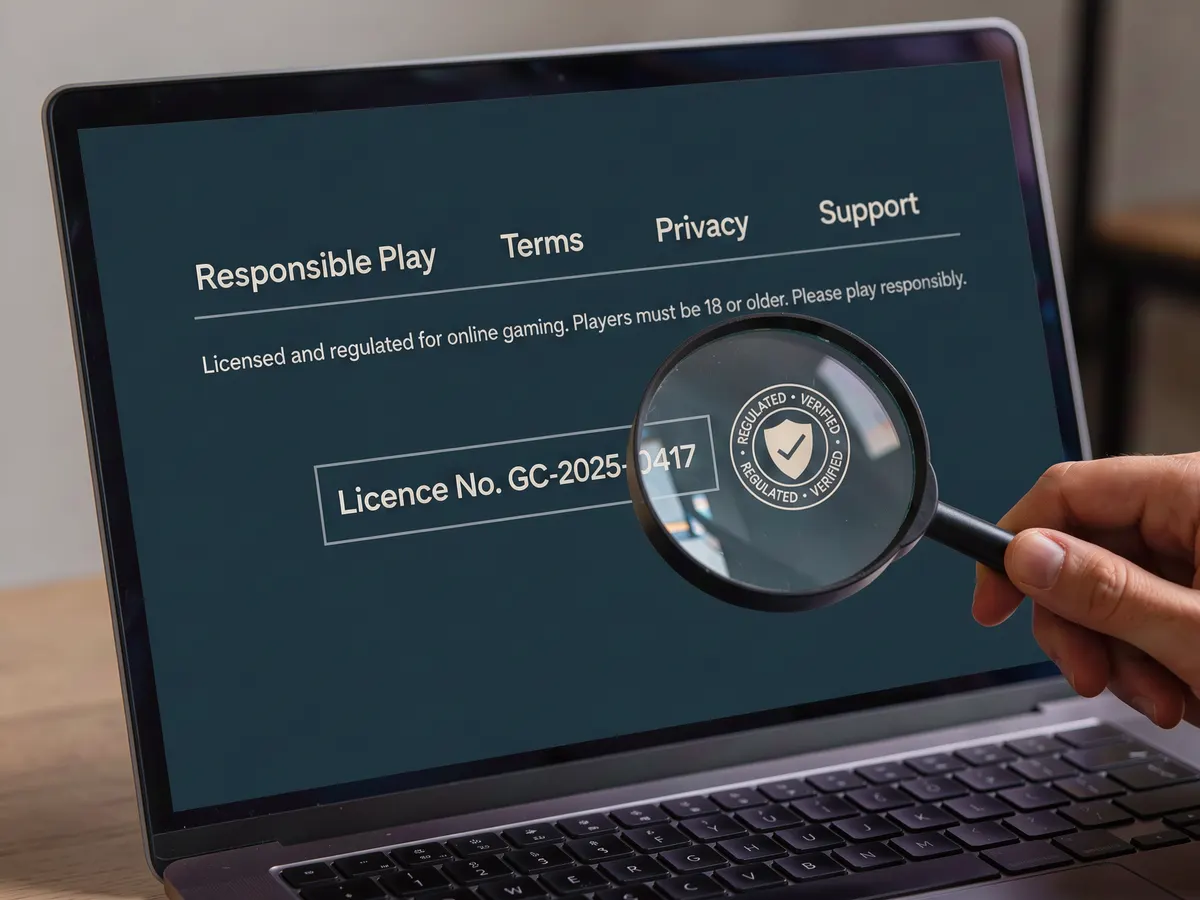
Why a casino licence matters more than the bonus, the reviews or the seal
You find a site you like, scroll to the bottom, see a small grey licence number beside a seal, and treat it as proof that somebody is watching. Usually nobody has checked that number, including you. Here is why a casino licence matters anyway: it is the only part of an online casino that a party other than the casino is contractually obliged to enforce. Games get tested by an outside lab, player deposits have rules about where they sit, identity checks are mandatory rather than optional, and a complaint can end up somewhere other than the operator’s own support inbox.
The popular advice is right. Only play at licensed sites. The reason people give for it is usually wrong. A licence is not a quality rating and it is not a guarantee you will be treated well. It is a set of obligations attached to a specific regulator in a specific market, and its value to you depends almost entirely on which regulator issued it and whether it covers people in your situation. That distinction is where the standard advice stops working.
A live example landed in October 2026. Wildz Group announced it had been granted a Finnish gambling licence, the first operator to publicly claim authorisation ahead of Finland’s regulated online market opening on 1 July 2027. It is a useful case precisely because it is messier than a footer logo suggests.
What a licence actually certifies
A gambling licence certifies three concrete things and one procedural one: that the games have been tested for randomness, that player money is handled under defined rules, that the operator runs identity and anti-money-laundering checks, and that complaints follow a documented path with a regulator at the end of it. Nothing in that list is about generosity, bonus size or payout speed.
Fairness and RNG certification
Licensed operators have to source games whose random number generators have been tested by an independent laboratory. The lab checks that outcomes are statistically random and independent, and that the game pays at the return to player figure the maths says it should. Testing does not make a game favourable to you. A slot certified at 96% RTP still carries a 4% house edge, which is the casino’s long-run mathematical advantage. Certification confirms the number is honest, not that the number is in your favour.
Where your deposit actually sits
Fund segregation is the rule that player balances are held separately from the company’s operating money, so a cash-flow problem at the operator does not automatically become your cash-flow problem. The strength of this varies more than most players expect. Some regulators require funds held in trust with an insolvency protection ranking, others require only that the money is identifiable. Read “segregated” as a spectrum, not a yes or no.
KYC, AML and the verification you will resent
Know Your Customer and anti-money-laundering checks are licence conditions, which is why a site asks for ID and proof of address before paying you out. Players read this as a stalling tactic. Sometimes it is used as one. But an operator that never asks is not being kind to you; it is a sign that nobody is enforcing the rulebook, and the same absence of checks is what makes a payout dispute unwinnable later.
The part that matters most is ongoing. A licence is a compliance obligation with periodic reporting, audits and renewals, not a certificate you frame once. Regulators can attach conditions, suspend, or decline to renew, which is why how casino licence renewals work tells you more about an operator’s standing than the original approval does.
The Wildz Finland approval, and the detail worth noticing
Wildz Group, a Malta-based company, says the Finnish National Police Board granted it a five-year licence allowing it to operate once Finland’s regulated online market opens on 1 July 2027. The group runs Wildz alongside Blingi, Caxino, Chipz, Spinz, Tuplaus and Wheelz, plus the Wildz Sports sportsbook. According to LCB, the National Police Board has not publicly confirmed the approval, so the operator’s own announcement is the basis for the claim that it was first.
Two things in that paragraph are worth separating. An operator voluntarily entering a stricter regulated regime, rather than serving that country from a lighter-touch base, is a meaningful signal about where it expects to be judged. That is not a recommendation to play there, and it does not help anyone today: the approval does not mean the Finnish market is open, and no licensed Finnish operation exists until mid-2027.
The second thing is the better lesson. Even a widely reported licence announcement was, at the time of reporting, unconfirmed by the regulator that supposedly issued it. If that is true of a news story, treat the number in a casino footer with the same scepticism. The announcement is a claim. The register is the evidence.
The myth that a licence is a licence
Licences differ enormously in what they oblige an operator to do and in whether anyone acts when the obligation is broken. The informal tiering is real: the UK Gambling Commission and the Malta Gaming Authority are well-resourced regulators with published enforcement actions, and Finland’s incoming system sits in the same category by design. Historically, several offshore regimes operated on a master-licence and sub-licence model with thin public enforcement, which is the reputational problem Curaçao has been reforming its framework to address.
| Criterion | Stricter regulators (UKGC, MGA, Finland from 2027) | Lighter-touch offshore licences |
|---|---|---|
| Game and RNG testing | Mandatory independent testing, with ongoing reporting obligations | Often required on paper, rarely audited in public view |
| Player fund protection | Defined segregation rules, with disclosure of the protection level in some regimes | Limited or unspecified; little insolvency protection |
| Dispute route | Regulator-backed complaints handling or approved ADR providers | Operator’s own process, sometimes a sub-licensor with no public procedure |
| Enforcement record | Published fines, licence conditions, suspensions and revocations | Little or no visible enforcement history |
| Responsible gambling tools | Required: deposit and loss limits, time-outs, self-exclusion | Varies by operator; often present but unaudited |
Checking a licence takes about four minutes
- Find the licence number in the site footer, along with the name of the company holding it. The holding company is often not the brand name on the page.
- Go to the regulator’s public register directly, by typing the regulator’s own address, not by clicking the seal. A seal that is just an image proves nothing.
- Search the register by company name or licence number and confirm the status reads active, with no suspension or condition attached, and that the expiry date has not passed.
- Check the permitted activities. A licence covering sports betting does not automatically cover casino games.
- Read the terms for the list of accepted countries and the licence that covers them. This is the step almost everyone skips, and it is the one that decides which rules apply to you.
- Treat independent testing seals from laboratories such as eCOGRA, iTech Labs or GLI as supporting evidence, verified on the lab’s site where possible, not as a substitute for a licence.
What recourse actually looks like when a payout stalls
Under a strong regulator, a delayed or refused payout has a formal path: you exhaust the operator’s internal complaints procedure, then escalate to a regulator-backed complaints unit or an approved alternative dispute resolution provider, and the operator risks fines, licence conditions or revocation if it ignores the outcome. Under a weak licence, or none, you have the operator’s support desk and nothing behind it.
Be realistic about the strong version too. ADR cases take weeks and sometimes months. Regulators supervise operators rather than collect debts for individual players, and a fine levied against a company does not automatically put money back in your balance. The process gives you leverage and a decision from someone independent. It does not give you speed.
Then there is the part the usual advice ignores entirely. A regulator’s dispute machinery exists to protect the customers of the market it licenses. A UK licence is there for customers in Great Britain; Finland’s regime will be there for customers in Finland. If you are depositing from outside those markets, the licence that governs your account is whichever one the operator uses to serve international players, and that is the register, the rulebook and the complaint route that apply to you. “They hold a UKGC licence” is not reassurance if your account does not sit under it.
What Indian players are actually choosing between
India has no single national online casino licence, and state rules differ sharply, with some states prohibiting online gambling outright. That means an Indian player evaluating an international site has no domestic regulator to fall back on, and the operator’s foreign licence becomes the main safety signal available. Practical checks, in order of how much they tell you:
- Verify the licence number on the issuing regulator’s register, and note which jurisdiction’s licence covers Indian customers under the terms.
- Read the withdrawal terms before depositing: minimum and maximum cashout, monthly payout caps, bonus-related withdrawal restrictions and whether KYC must be completed first.
- Confirm payment reality, including whether UPI or bank transfers are supported for withdrawals, not only deposits.
- Look for working responsible gambling tools: deposit limits, loss limits, session reminders, cool-off and self-exclusion, set from inside the account rather than by emailing support.
- Walk away from any site with no visible regulator, an expired entry, or a seal that links nowhere.
Gambling has a built-in house edge, which means losing is the expected outcome over time; set a deposit limit before you play, treat the money as spent entertainment rather than income, and use self-exclusion or a support service if it stops feeling optional.
None of this makes the choice safe, only informed. Finland’s regime will not be tested until operators are live in it from July 2027, and Curaçao’s reforms will be judged on enforcement actions nobody has seen yet. Until then, the only question you can answer today is a narrow one: which regulator covers your account, and what has that regulator actually done to an operator that misbehaved?
About The Author



1 thought on “Why a Gambling Licence Matters When Choosing an Online Casino”