Does a casino actually revive a town centre?
Ask the people walking out of one, and a sizeable share will tell you they would not have come into town at all. That is the headline of new research from the Betting and Gaming Council, the UK trade body for regulated betting and gaming, which argues that casinos pull visitors into town and city centres who would otherwise have stayed home. It is the clearest recent attempt to put numbers on the casino tourism economic impact in Britain, and the numbers are real survey answers rather than guesses.
They are also customer survey answers, which is a specific and limited kind of evidence. Below is what the report actually claims, the mechanisms behind footfall and spillover spend, and how all of this compares with the online gambling model most readers of this site deal with every week.
What the Betting and Gaming Council report found
The research found that 41.1% of surveyed casino customers said they would have stayed at home if a casino visit had not been available. A further 55% said they would probably or definitely not have visited the area otherwise, and 72.1% reported using at least one other local business during the same trip.
Read those three figures carefully, because they are doing different jobs. The first two are counterfactuals: people describing a trip they did not take. The third is closer to observed behaviour: a visitor saying they also went to a bar, a restaurant, a car park or a hotel on the same night. That last number is the sturdiest of the set, and it is the one that matters most to the shops and kitchens around the casino.
The BGC is an industry body making an industry case, which does not make the data wrong. It does mean the framing is advocacy, and the honest way to use it is to treat the percentages as a snapshot of what casino customers say about their own trips, not as a measured before-and-after study of town centre footfall.
How land-based casinos pull footfall into a town centre
A casino generates local economic activity because it keeps people in one place for hours, at times when almost nothing else is open. Dwell time is the mechanism. A cinema holds a visitor for two hours on a fixed schedule; a casino floor has no closing credits, and the typical visit runs late into the evening in a district where restaurants have already turned their last tables.
Spillover spend on hospitality and leisure
The 72.1% figure is the spillover in action. A casino trip rarely happens alone: there is a meal before, a drink after, a taxi both ways, sometimes a hotel room if the group has travelled in. Casino venues themselves run food and beverage operations, but the surrounding hospitality sector captures a share of the same evening, and that share arrives concentrated in a few streets rather than spread thinly across a region.
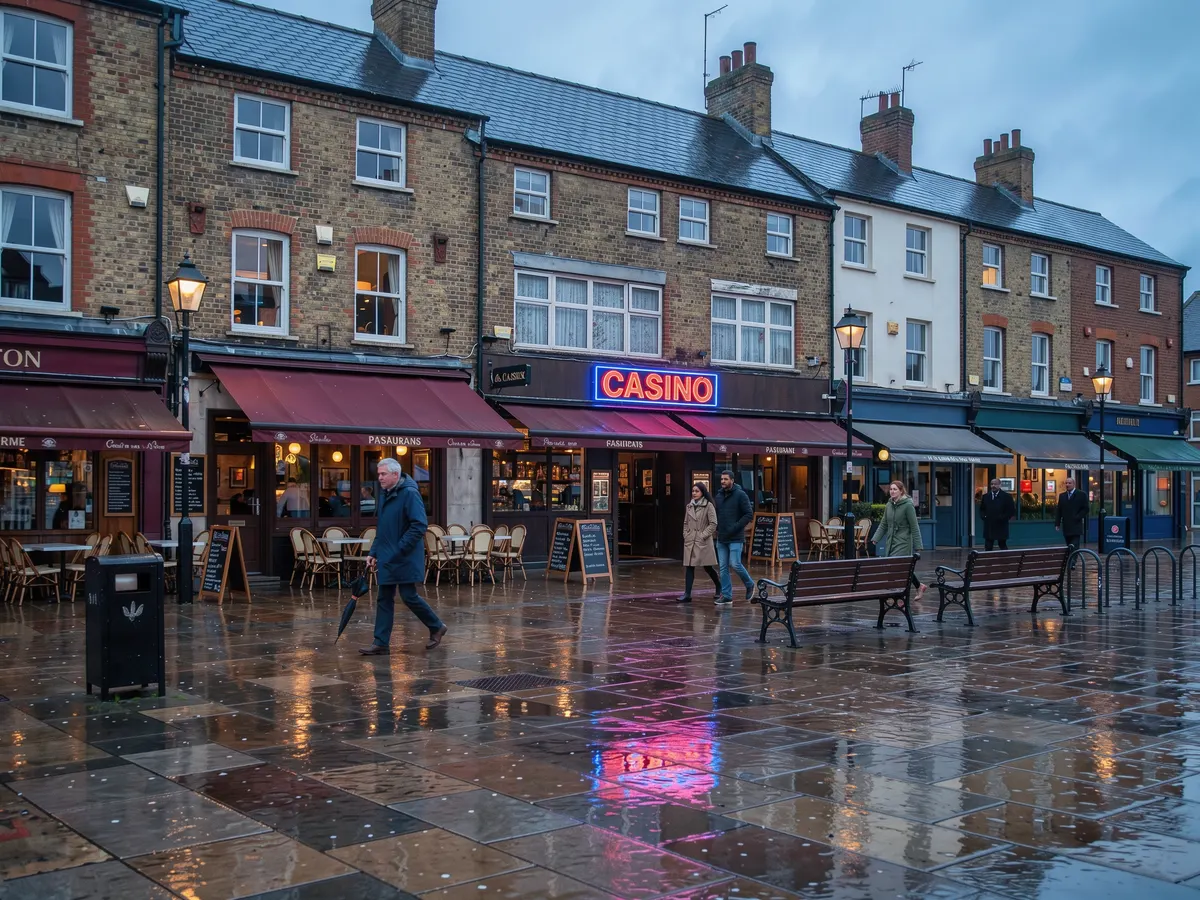
The size of that spillover depends heavily on what else is nearby. A casino on a high street with twelve independent restaurants leaks spend into all of them. A casino in an out-of-town leisure park with its own car park and its own kitchen captures nearly everything internally, and the town centre sees very little. The report’s findings describe the first case. Applying them to the second is where the argument quietly stops holding.
Jobs and the night-time economy
Casinos are staff-heavy by design. Dealers, inspectors, cashiers, security, surveillance, compliance officers, kitchen and bar teams: a live gaming floor cannot be thinned out the way a retail unit can, because the games require a human at every table and the regulator requires humans watching them. Those roles are fixed to a postcode. The dealer spends their wages near where they work, and the venue pays business rates to the council that collects them.
That same staffing intensity is why the land-based model is fragile when costs move. UK operators have closed venues when duty rates rose, and the arithmetic is unforgiving: a casino with a large payroll and a fixed building has very little room to absorb a tax increase. If you want the detail on that squeeze, we have covered how rising gambling taxes can force casinos to close in a separate piece.
Casino vs online gambling: where the economic benefit actually lands
Online gambling produces economic value too, but almost none of it is geographic. An online casino serving a town needs no building in it, no dealers living there, and no taxis queuing outside at 1am. Its contribution shows up as corporation tax, gambling duty, licensing fees, marketing spend and a technology payroll that may sit several countries away from the player.
| Dimension | Land-based casino | Online casino |
|---|---|---|
| Where benefit lands | Specific town centre | Operator’s base and tax jurisdiction |
| Local employment | High, fixed to the venue | Low locally; concentrated in tech and support hubs |
| Spillover spend | Bars, restaurants, hotels, transport | Essentially none |
| Cost of scaling | New building, new licence, new staff | Marginal; new players need no new premises |
| Access window | Opening hours, travel required | Constant, from a phone |
That bottom row is the one with the sharpest consequences. The friction of a land-based visit, the journey, the door, the closing time, doubles as a natural brake on play. Online has no equivalent brake, which is exactly why online operators carry heavier obligations around deposit limits, affordability checks and self-exclusion tools. The two models are not the same product delivered through different channels; they behave differently for both the local economy and the individual player.
Gambling tourism trends beyond one survey
The destination-casino idea is older and better established than any single footfall study. Las Vegas, Macau and Singapore’s integrated resorts were all built on the premise that gaming floors anchor hotels, conference space, restaurants and arenas, with the gambling subsidising the rest. Regional British casinos operate at a different order of magnitude entirely, and nobody is flying in for a weekend at a provincial venue.
What the BGC data suggests is something more modest and more local: a casino can function as an evening anchor for a town centre the way a theatre or a concert hall does. That is a reasonable claim. It is not evidence that casinos drive regeneration, and one survey of customers in one market cannot be stretched into a general law about gambling tourism trends anywhere else.
The caveats worth weighing
Correlation is the first problem. Casinos are licensed into places that already have night-time economies, transport links and licensing districts, because those are the places where a casino makes commercial sense. A busy street around a casino may be busy for the same reasons the casino chose the street. Separating the two would need footfall data from before and after an opening, not a survey of people already inside.
Self-reported counterfactuals are the second. Asking someone whether they would have stayed home tends to produce a generous answer, and the question is hard to answer accurately even in good faith.
The third is harder to quantify and more important. Casino revenue is not evenly distributed across customers; a meaningful share of industry turnover comes from heavy users, and some of those people are gambling more than they can afford. A town centre propped up by casino spend is, to some degree, a town centre propped up by losses, with the house edge working steadily in the operator’s favour on every game on the floor. Over-reliance on gambling revenue is a real planning risk, and so are the social costs that sit outside any footfall figure. If gambling has stopped being entertainment for you, GamCare and the National Gambling Helpline offer free, confidential support.
What the two models reveal about the casino economy
The useful finding here is not that casinos save high streets. It is that land-based gambling is the only part of the sector whose economics are welded to a place, and that this is both its civic argument and its structural weakness. A casino cannot move when rates rise, cannot shed staff when duty climbs, and cannot grow without building something. Its upside is that it leaves money in the postcode; our look at what rising US casino revenue figures show about industry growth makes the same point from the revenue side.
Online carries no such weight and no such anchor. It scales without premises, pays its contribution as tax rather than footfall, and reaches players in towns where no casino would ever be viable. Which model a government prefers is, in the end, a question about what it wants from gambling revenue: a street that stays open after midnight, or a line in the Treasury’s receipts. The BGC report argues for the first. It does not settle whether the trade is worth making.
About The Author