Spooky Link debuted on a casino floor, not online
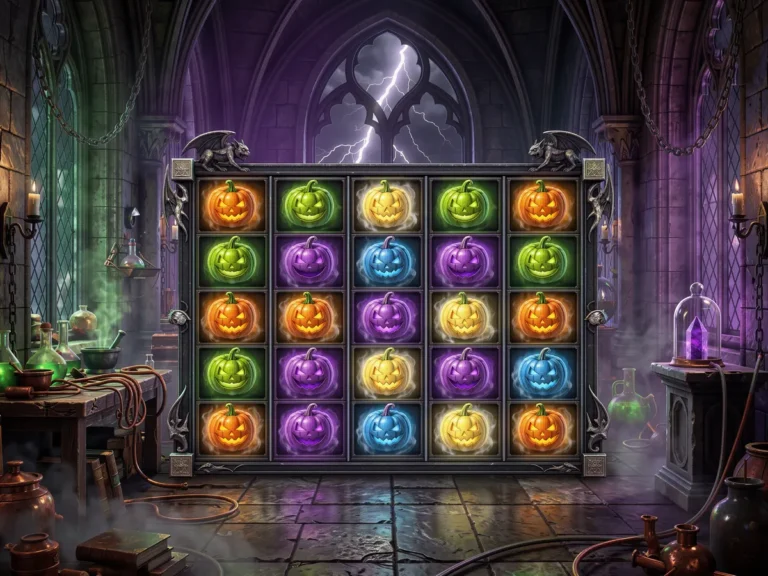
Spooky Link Grand launched on February 18, 2026 at Mohegan Sun, with nationwide distribution set to expand from there. The Spooky Link slot game is an Aristocrat franchise that now runs in both channels: the Grand cabinet is the land-based release, while an online real-money version, Spooky Link: Go Ghost, is already listed by FanDuel Casino with wagers from $0.20 to $1,000 per spin. The Mohegan Sun rollout was handled by Aristocrat Gaming, the company’s land-based division, rather than by Aristocrat Interactive, its online real-money gaming business, and further games from the franchise are planned through 2027.
That is the whole confirmed story. The announcement covers the debut venue, the plan to widen distribution and the roadmap. It does not publish an RTP figure, a volatility rating, a hit frequency or a jackpot seed value, and anyone quoting those numbers for this specific title is guessing or reading an info panel you haven’t seen yet. So the useful thing to do with a launch like this is not to speculate about one game, but to understand what the word “Link” promises and what it quietly costs you.
What does “Link” actually mean on a slot?
A Link slot is one where a family of related games feeds a shared prize pool and uses a common trigger feature to award it. The jackpot tiers grow from wagers placed across the whole network of linked titles, not just from the game you happen to be sitting on, which is why the top prize can reach a size no single standalone slot could fund on its own.
How the pool gets funded and triggered
A slice of every qualifying wager on every game in the network is diverted into the pool. You are not getting that slice back in the base game; it sits in the meter until someone, somewhere on the network, triggers the award. In most designs the trigger is a dedicated feature rather than a line win: you collect a set number of special symbols, which locks the reels into a respin or hold-and-spin round, and the prize tier you land depends on what you fill during it. Tiers are usually stacked, with small frequent ones at the bottom and a network-wide top prize that may go months without dropping.
Two things follow from that structure. The pool being large does not make it closer to hitting: outcomes come from an RNG and each round is independent of every round before it, so there is no such thing as a jackpot that is “due”. And the reason operators like the format is engagement across a set of titles rather than generosity. One shared meter gives players a reason to move between five themed games instead of one.
Why “check the RTP first” is right advice for the wrong reason
Checking the return to player figure before you spin is correct, and almost everyone recommends it for a reason that doesn’t hold: they treat it as a forecast of their session. It isn’t. RTP is a long-run average measured over millions of rounds, so a published 96% means roughly 96 units returned per 100 wagered across that whole sample, and a 4% house edge sitting permanently on top. It tells you nothing about tonight.
On a linked-jackpot game the figure matters for a different and more practical reason. The headline RTP typically includes the jackpot contribution, which is money returned to the network rather than to your account, and in many designs the top tier is only in play at or above a certain bet level. Two players on the same game at different stakes can therefore be playing two different return profiles, and the smaller stake is often the one quietly funding a prize it cannot win.
That is the trade-off, and it has no clean resolution. Bet up to qualify and your cost per spin climbs while your bankroll meets a feature that triggers rarely by design. Bet below the threshold and you accept a thinner return on a game whose main attraction you have opted out of. My own read: if the only thing drawing you to a linked slot is the Grand, and the qualifying bet is more than you would comfortably stake on an ordinary slot, the honest answer is to skip it. There is nothing wrong with concluding that a game isn’t for you.
Why Halloween themed slots cluster in October
Seasonal releases are a marketing calendar decision. The pattern is industry-wide: studios ship pumpkin, ghost and haunted-house themes in autumn, Christmas titles in December, and the art, symbol set and soundtrack get rebuilt around the season while the underlying mechanic usually stays whatever the studio already had working.
Which is the point worth holding onto. A seasonal skin tells you when a game was scheduled, not how it pays. The theme is the reason it is in front of you in October; the paytable and the bet requirements are the only things that describe what happens when you press spin.
What slot volatility means, and why it should change how you play
Volatility is how a game distributes its returns over time. High volatility means wins are rarer but larger when they come; low volatility means frequent, smaller wins and a steadier balance. Volatility does not change RTP at all. Two games can both return 96% in the long run while feeling completely different to play.
Hit frequency is a separate measure again: it describes how often any win lands, not how big it is. A game can hit often and still be swingy if most of those hits are below your stake.
High and low volatility in practice
| What changes | Low volatility | High volatility |
|---|---|---|
| Win frequency | Frequent | Infrequent |
| Typical win size | Small, often under stake | Large, concentrated in features |
| Balance movement | Gradual drift | Long flat stretches, sharp spikes |
| Session length on a fixed budget | Longer | Shorter and less predictable |
| Sensible stake per spin | Can run closer to your limit | Smaller, to survive dry spells |
Linked-jackpot games sit firmly at the high end, because the prize structure takes money out of ordinary wins to build a pool awarded rarely. Practically, that means dividing your budget into more, smaller spins rather than fewer large ones if you want the feature round to be a realistic possibility within your session. It does not improve your odds. It only changes how long you last. Any new release that publishes a confirmed RTP and volatility rating is easier to judge on this front than one that doesn’t, which is why new slot reviews that confirm RTP and volatility are more useful than hype-led previews.
The bonus features games in this category usually carry
Nothing below is confirmed for Spooky Link Grand specifically, since the launch announcement doesn’t detail the feature set. These are the mechanics that recur across Aristocrat slots and link-style games generally:
- A hold-and-spin or respin round where cash-value symbols lock in place, which is the usual route to the jackpot tiers in hold and win bonus rounds
- Free spins triggered by scatter symbols, sometimes with extra reels or added wilds
- Multipliers applied inside the bonus round rather than the base game
- Pick-a-prize screens where a choice reveals a cash amount or a tier
- Tiered jackpots, commonly four, with the smallest hitting regularly and the largest shared across the network
- Wild substitutions and collection meters that persist between spins
Read the game’s own info panel rather than any article, including this one, for which of these actually appear and what triggers them.
Five checks before you spin a new linked jackpot slot
- Open the info panel and find the RTP, since operators sometimes run different configurations of the same game.
- Play the demo version first if one is offered, long enough to see the feature trigger at least once.
- Find the minimum bet required for jackpot eligibility, and decide whether you are willing to stake it.
- Set a loss limit and a session length before the first spin, using the operator’s own deposit and loss limit tools.
- Confirm the game is legally available to you from where you are, on a licensed operator, before depositing anything.
Can you play Spooky Link in India?
Not on the basis of the online release that exists today. Spooky Link: Go Ghost can be played online for real money through FanDuel Casino, at stakes between $0.20 and $1,000 a spin, but a game being online with one operator does not make it reachable from everywhere. Real-money online slot access depends on jurisdiction, on whether an operator holds a licence valid for your location, and on the game’s own territorial licensing, all of which can differ for the same title in two countries.
For readers in India, the legal position on real-money online gaming is governed by national and state-level law and is not uniform, so the sensible step is to check the current rules that apply to you rather than assume a well-known franchise is accessible to you because it is live somewhere. Free demo versions of a game sometimes circulate where the real-money version does not, and those are not the same thing. Where any winnings are involved, Indian tax rules on net winnings apply separately from the question of legality.
The number the jackpot meter never shows
A pool is only large because it rarely pays. That is the mechanic, not a flaw in it, and the longer a network-wide tier goes unawarded the more it advertises its own rarity rather than any improving chance. Slots are built with a house edge, they are entertainment rather than a way to make money, and a Halloween skin on a franchise with a strong land-based record does not alter either fact.
So the question a new linked-jackpot release leaves genuinely open is not whether it is a good game. It is whether the qualifying bet is a price you want to pay for a feature that may not show up this month. Decide that figure before you load the game, not after a dry run of fifty spins, and if the answer stops feeling like a choice, use the deposit limits, cool-off and self-exclusion tools your operator is required to provide, or contact a gambling support service in your country.
About The Author