What Tower Run: Treasure Steps actually is
The tower in this game is not a ladder you climb one rung at a time, banking your prize when your nerve runs out. Tower Run: Treasure Steps slot is a 5×5 cascading grid game from Play’n GO, launched on 15 October 2026, where matching symbols pay anywhere on the grid and nine wins inside a single spin open a Hold & Spin bonus called the Treasure Room. The climb of the aspiring knight Bob is a progression the game tracks for you, not a decision it hands over.
That distinction matters more than it sounds. “Climb-and-collect” has become a marketing shorthand for games built around a cash-out choice, the kind where you weigh a guaranteed step against a bigger one. Read the launch material for Tower Run: Treasure Steps and you find something different: a cascading cluster slot with a counting trigger bolted to a sticky-symbol bonus. Players who load it up expecting to make choices will spend a lot of spins waiting for a choice that never arrives.
Where this Play’n GO new slot sits in the catalogue
Tower Run: Treasure Steps is a character-led fantasy title from Play’n GO, one of the larger slot suppliers serving regulated online casinos, and it leans on the studio’s habit of building a game around a named protagonist rather than a generic theme. Bob is an aspiring knight with, in the studio’s own framing, plenty of optimism and a distinctly limited amount of experience.
Structurally it belongs to the cascading cluster family rather than the payline family. There are no reels spinning past fixed lines here. Symbols land on a 5×5 field, matching groups pay regardless of position, winning symbols clear, and new ones drop in. Anyone who has played cluster slots knows the rhythm: one spin can resolve in half a second or roll on through five or six consecutive clears.
How the tower-climb bonus mechanic works
The Treasure Room unlocks when a single spin produces nine wins, counted only after every cascade from that spin has finished. The trigger is not nine matching symbols and not nine spins. It is nine separate winning events inside one chain of cascades, which is a far narrower door than the headline number suggests.
The nine-win trigger, and the clause that qualifies it
“Nine wins in a single spin” reads like something that might turn up a few times an hour. Add the qualifier and it changes shape. Each cascade has to keep producing new wins; the moment a drop lands with no match, the chain stops and the count stops with it. Getting to nine means a spin that refuses to die eight times in a row. In cluster games that behaviour is a tail event, not a weekly occurrence.
The practical cost of misreading this is bet sizing. If you treat the bonus as a regular feature and stake accordingly, you are funding a long base game with money allocated to a bonus you may not see for hundreds of spins. The honest way to budget a game like this is to assume the Treasure Room is rare and size your bet so that the base game alone is affordable for the session you intend to play.
What the climb tracks, and what it does not
Bob’s ascent is a progression display tied to the game’s structure, and the launch material does not describe a per-step multiplier ladder or a player-facing collect-or-continue decision. No published figure sets out what each step pays or multiplies. If you have seen a write-up confidently listing step values, check whether it came from the paytable or from an assumption about how climbing games usually work.
This is the one place where restraint is required. The in-game information screen is the authority on whether the climb carries any player choice, whether progress persists between spins, and what resets it. Until you have read it, treat the climb as presentation layered over a cascade counter.
Inside the Treasure Room: sticky Coins, Mimic Chests and Keys
The Treasure Room is a Hold & Spin round rather than a free spins round, which is worth saying plainly because the two get used interchangeably and they do not play alike. Coins land and stick. Mimic Chests also land, but they hide their value until one of two things happens: their countdown expires, or a Key opens them early.
That hidden-value wrinkle is the interesting part of the design. In a standard Hold & Spin you can read your board and roughly know where you stand. Here part of the board is deliberately unreadable, so a round that looks modest can resolve differently once the chests open, and a round that looks promising may not. It makes the bonus feel less deterministic than its genre usually does. It does not make it more generous, and nothing about hidden values changes the long-run return.
RTP and volatility: what is confirmed and what is not
Tower Run: Treasure Steps launched with a published RTP of 96.2%, a volatility rating listed as high by some sources and mid-high or medium/high by others, and a maximum win of 30,000x the bet. Online slots typically return somewhere in the 93% to 97% range, with the industry-standard average sitting around 96%, so 96.2% lands marginally above the middle of the pack rather than anywhere remarkable. Several suppliers also ship games in more than one RTP configuration with the operator choosing which version to run, so the number on the information screen at the casino you are playing at is the one that applies to you.
On volatility, the spread in the published ratings is itself informative. A cascading cluster base game with a nine-win trigger feeding a sticky-symbol bonus concentrates value in an event most sessions will not reach, which is why the structure reads high even where a listing says medium/high. Expect long flat stretches punctuated by rare larger rounds, and expect the 30,000x cap to be a theoretical ceiling reached by a vanishingly small fraction of Treasure Room rounds rather than a realistic target.
| Spec | Confirmed at launch | Check in the game info screen |
|---|---|---|
| Grid and wins | 5×5, matching symbols pay anywhere | Minimum cluster size, symbol values |
| Cascades | Yes, wins clear and new symbols drop | Whether cascades carry any multiplier |
| Bonus trigger | Nine wins in one spin, counted after all cascades | Retrigger rules |
| Bonus type | Hold & Spin: sticky Coins, Mimic Chests, Keys | Number of respins, reset conditions |
| RTP | 96.2% | Whether your operator runs an alternative RTP version |
| Volatility | High (listed as mid-high or medium/high elsewhere) | Provider’s rating as displayed in-game |
| Max win | 30,000x the bet | How the cap is worded in the paytable |
How to play Tower Run: Treasure Steps in practice
Play’n GO titles reach players through licensed operators rather than direct from the studio, so availability depends on which casinos in your market carry the supplier and whether the game has cleared each regulator. In India, where access depends on your state’s rules and the operator’s licensing, check both before depositing.
- Open the demo first. Most sites that carry Play’n GO offer free play, and a hundred demo spins will tell you more about the cascade rhythm than any review will.
- Read the information screen. The RTP your operator actually runs, the volatility rating, the win cap and the exact Treasure Room rules live there, and they override anything written elsewhere.
- Set your stake against the base game, not the bonus. Divide the amount you are willing to lose by the number of spins you want, and bet that. A bonus you may never trigger is not a budgeting assumption.
- Check bonus terms if you are using one. Game weighting and max bet caps while a bonus is active can quietly invalidate a win, and cluster slots with long cascade chains are easy to over-bet on.
- Move to real money only once the pacing suits you. If the dead stretches irritate you in demo, they will irritate you more with your own rupees on the line.
Theme, visuals and the pacing problem
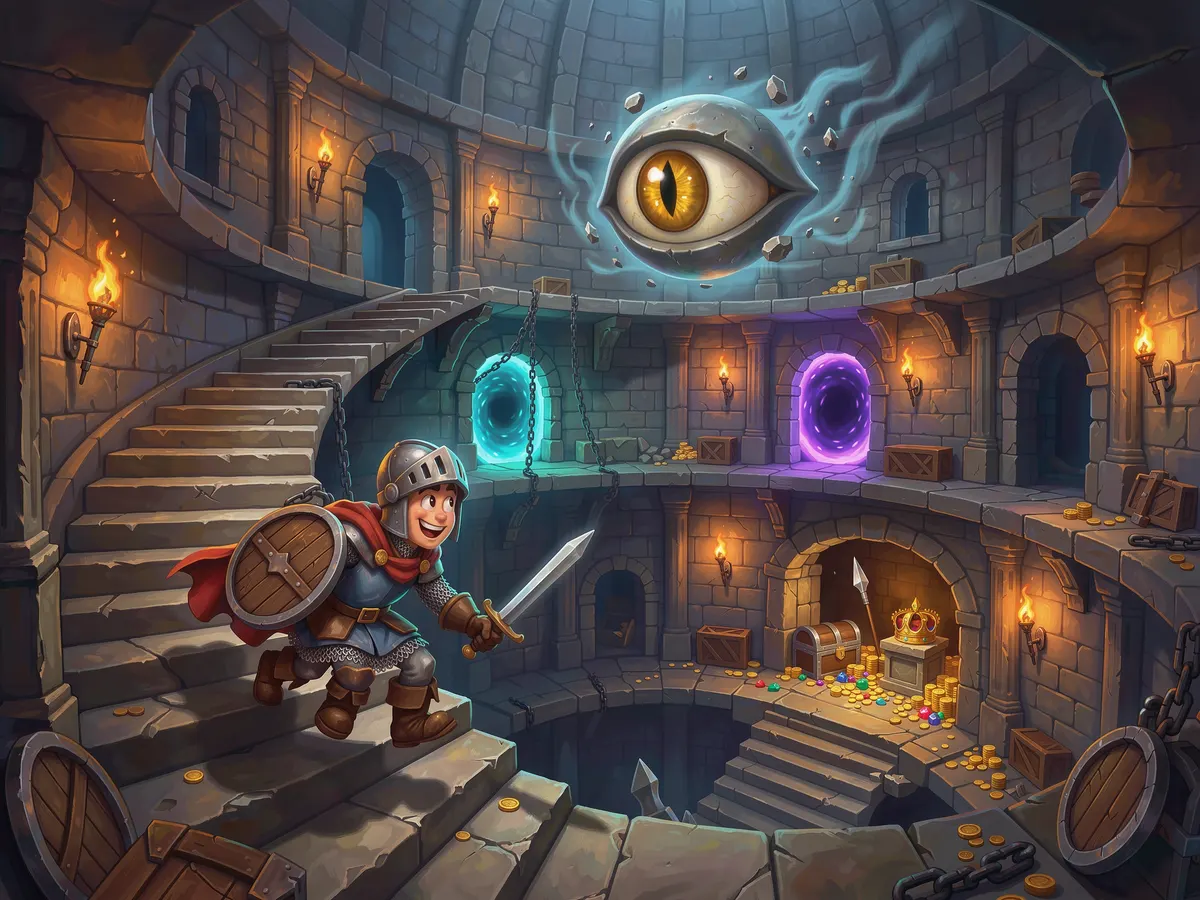
The setting is a mysterious Treasure Tower rendered as suspended walkways, strange portals and heavy stonework, with a giant floating eye supervising the whole affair. The tone is comic rather than epic. Bob is an underdog, the humour is gentle, and the art does not take its own fantasy seriously, which is a relief in a genre that often does.
Pacing is the real difference from a conventional slot. Cascades stretch individual spins out, so sessions feel slower and less uniform than a five-reel game with a fixed spin length. Combine that with a bonus gated behind a nine-win chain and the game spends most of its time in a holding pattern. Some players find that absorbing. Others find it tedious. Twenty minutes of demo will sort you into one camp or the other.
Who this one is for
Tower Run: Treasure Steps suits players who are comfortable with long dry spells and are playing for the bonus rather than for steady base-game returns. If you prefer frequent small hits, a game whose main feature sits behind a cascade chain that has to survive eight times over is working against your preferences.
This is a first-look assessment built on launch information, not on thousands of recorded spins, and it has limits worth stating. A 96.2% RTP, a high volatility rating and a 30,000x cap describe the shape of the maths; they say nothing about how often the Treasure Room actually opens, and no published figure gives that trigger frequency. What can be said is that the climb is presentation rather than agency, the nine-win trigger is tighter than the phrase implies, and the Mimic Chests are a genuinely novel twist on a well-worn bonus format.
A word on playing sensibly
No slot can be beaten over time. Every game in this category, this one included, is built with a house edge, and the cascades and sticky coins change how the maths feels without changing the fact that it favours the operator. Play only if you are of legal age in your jurisdiction, which varies by state and country and is commonly 18 or 21 depending on the game type, use the deposit, loss and session limits your operator provides, and treat the money as the price of entertainment rather than as a stake in something that pays back. If your play stops feeling optional, cool-off and self-exclusion tools are available in every licensed account.
About The Author





2 thoughts on “Tower Run: Treasure Steps Slot Review: How Play’n GO’s New Climbing Game Works”