No slot pays better because it is October. Halloween themed slots run on the same random number generator and the same built-in house edge on 31 October as they do in April, and a pumpkin on the reels has never shifted a single decimal of return to player. What changes in October is the release calendar, and Evoplay has just added to it: The Castle of Slotenstein, a Frankenstein-inspired slot built around a Hold & Win bonus, arrived in mid-October ahead of Halloween 2026. That makes this a decent moment to separate the two things players usually blur together, the atmosphere a horror slot sells you and the maths it actually runs on.
What Evoplay confirmed about The Castle of Slotenstein
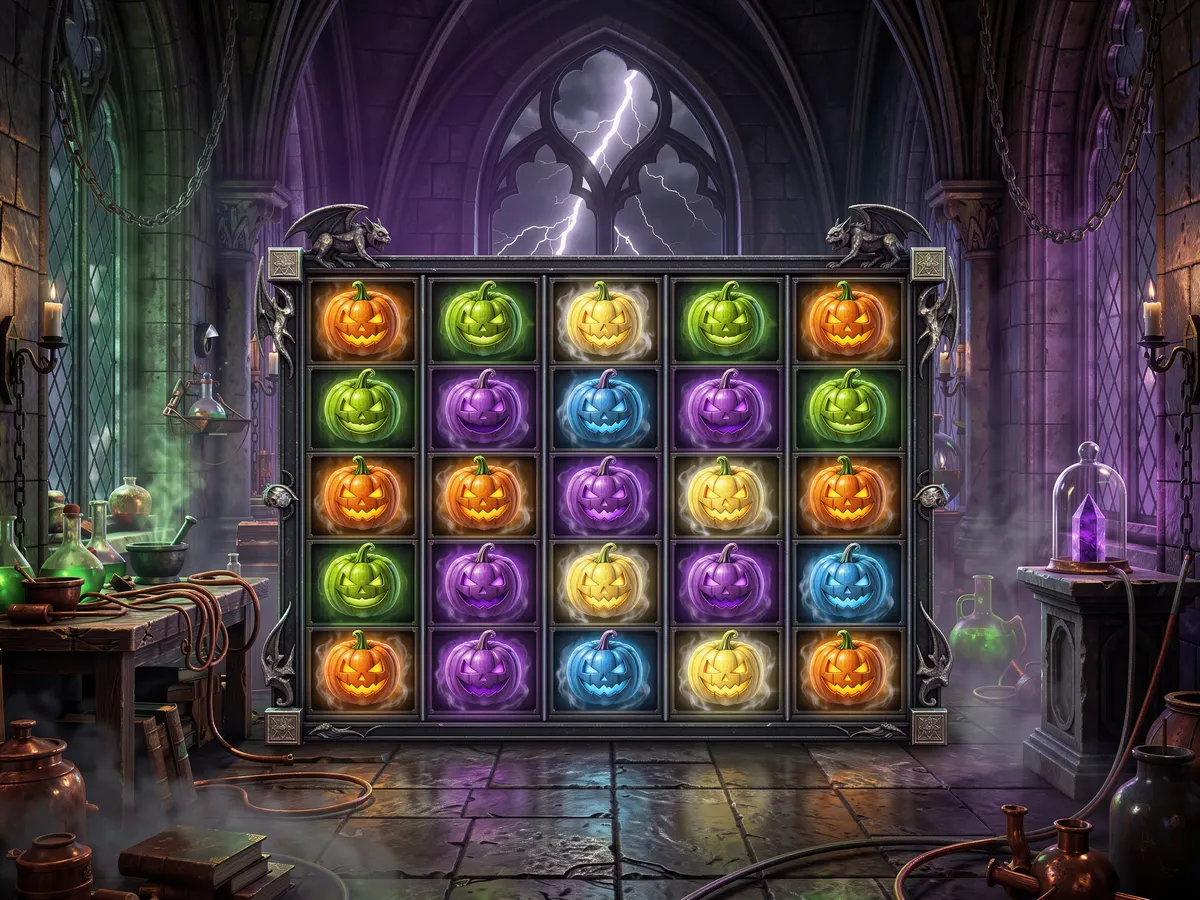
The Castle of Slotenstein is a Halloween release from Evoplay in which three booster symbols feed a Hold & Win bonus round. The setting is a mad scientist’s castle and his towering creation, and the mechanics hang off coloured pumpkin Bonus symbols, each tied to a different effect.
Green Shock symbols lift the opening number of Bonus Game spins from three to four. Purple Trick symbols can add extra Bonus symbols to their reel or raise the value of ones already there by up to 5x. Blue Treat symbols add their own values to every Orange Bonus symbol sitting on the grid. Once the Bonus Game starts, only Bonus symbols land, and every new one resets the spin counter, which is the classic Hold & Win tension loop: you are never quite out of spins until you are.
Evoplay also published the numbers that matter most. The game page lists an RTP of 96.20%, volatility rated low, and a maximum win of €234,562. A 96.20% return means a 3.8% house edge, which sits around the middle of the slot range, and the low volatility rating is consistent with a Hold & Win design that pays in smaller, more frequent amounts rather than rare large hits. It is still worth opening the in-game information panel or the operator’s game info page on the site you are actually playing at, because providers often ship a title with more than one RTP configuration and the operator picks which one goes live.
Why gothic horror fits slot design better than most themes
Gothic and horror themes work in slots because dread is a pacing device, and a slot is fundamentally a pacing machine. Fruit symbols carry no anticipation. A locked laboratory door, a counter ticking down, a creature half-assembled on a slab, these all borrow the grammar of a horror film: delay, then reveal.
That maps onto bonus mechanics that were already built around suspense. Hold & Win rounds hold their resolution back for several spins. Pick-and-reveal bonuses hide a prize behind a choice. Escalating multipliers climb while the player waits for them to stop. Dress those in a haunted castle and the mechanic and the fiction reinforce each other instead of sitting side by side.
There is a commercial logic too. Interest in anything Halloween-flavoured spikes for a few weeks each autumn, so a gothic release lands in a window where players are already searching for it, lobbies are already promoting a seasonal row, and a studio gets more attention for the same development spend. None of that touches the house edge. A beautifully built horror slot and a plain one with identical maths return the same amount over the long run.
Theme or paytable: which one should pick the game?
The paytable should pick the game, but the theme is not irrelevant noise, and the version of this advice that says “ignore the skin, read the numbers” is too clean to be useful.
Here is the case for the purist reading. Theme is decoration layered over a mathematical model. The reels, the hit frequency, the distribution of outcomes and the return percentage were all fixed before an artist drew a single gargoyle. Two slots with the same RTP and the same volatility profile will behave the same whether one is set in a crypt and the other on a beach. On that logic, anything you feel while playing is marketing working on you, and the only rational input is the information panel.
The case against is simpler than it looks: theme changes how long you sit there. A slot whose atmosphere grips you is a slot you play more spins on, and more spins means more total stake exposed to the same edge. That is a real effect on your money even though it is not an effect on the game’s maths. It cuts the other way too. If a theme leaves you cold, you close the tab after twenty spins and spend less, which is not a strategy but is an outcome.
So I come down on the side of the numbers, with one amendment. Read the paytable first and let it decide whether the game is one you can afford to play at the stake you have in mind. Let the theme decide only between games that already passed that test. What the standard advice gets wrong is implying the theme has no consequences at all, when the consequence is behavioural rather than mathematical, and behavioural is where most players actually lose control of a session.
The five minute check before your first real spin
Four things in the game information panel tell you almost everything you need: RTP, volatility, the bonus mechanics, and the maximum win expressed as a multiple of your stake. Seasonal slot releases are no exception, and new titles deserve more scrutiny than familiar ones precisely because no one has written about them yet.
Volatility and RTP tell you different things
RTP is the long-run share of all wagers a game returns, averaged over millions of rounds; volatility describes how those returns are distributed. A 96% RTP game has a 4% house edge whether it pays in small frequent dribbles or rare large hits. Most slots sit somewhere in the mid-90s, and a percentage point of RTP is worth more to you over time than any feature on the reels.
Higher volatility is not better. It is a different shape of the same expected loss, with longer dry spells in exchange for bigger but rarer outcomes, and it chews through a small bankroll faster in the meantime.
| Volatility | Win frequency | Swing profile | What it asks of your bankroll |
|---|---|---|---|
| Low | Frequent, mostly small | Shallow, steady | Modest; sessions last longer at the same stake |
| Medium | Moderate | Noticeable but survivable runs | Middling; the usual compromise |
| High | Infrequent | Long dry spells, occasional large hits | Larger, or a much smaller stake per spin |
A published max win of several thousand times stake is also a volatility signal in disguise: that ceiling has to be paid for somewhere, and it is paid for with the base game being quieter. For another recent release with both figures confirmed at launch, see our breakdown of Play’n GO’s Tower Run: Treasure Steps and its climbing bonus.
Read the bonus features, not the trailer
Horror slots lean on a small set of recognisable features: free spins, escalating or fixed multipliers, pick-and-reveal rounds, expanding wilds, and Hold & Win respins of the kind Castle of Slotenstein uses. What matters is the condition attached to each one. How many scatters trigger the free spins, and how often does that realistically happen? Does the multiplier reset between spins or carry? If there is a bonus buy option, work out how many base-game spins the same money would have bought, because buying the feature does not improve the game’s return and in some titles the bought version runs at a different RTP entirely.
Demo play is free information
Play the demo before you wager. Fifty or a hundred demo spins will not reveal the RTP, and they cannot predict anything about your real-money session, but they will show you the pace of the base game, how often features actually appear, and whether the thing you were sold on the promo image is fun after ten minutes. If a game only becomes interesting during a bonus round you have not seen in a hundred spins, that is worth knowing before money is involved.
Where The Castle of Slotenstein sits in the Halloween release cycle
It is one entry in a seasonal pattern that repeats every year. Studios time gothic and horror titles for October because lobbies build Halloween categories, affiliates publish roundups, and player interest arrives on schedule. Evoplay slots have landed in that window with a Frankenstein premise and a Hold & Win hook, which is a sensible read of what the season rewards: a recognisable monster story attached to a mechanic players already understand.
Being a seasonal release tells you about the marketing calendar and nothing about the game’s quality or its return. Treat the timing as the reason you heard about it, not as evidence. The questions that separate a good October release from a forgettable one, which is to say the RTP, the volatility, the trigger frequency and the ceiling, are the same questions you would ask in February.
Keeping Halloween themed slots in the entertainment budget
Halloween themed slots are chance-based games with a house edge that the theme does not change. Decide the amount you are prepared to lose before you open the game, set a deposit or loss limit and a time limit in your account tools, and treat a new release as a thing you paid to see rather than a thing you expect to profit from. Deposit limits, session reminders and self-exclusion exist at every licensed operator and take a minute to switch on.
And on Castle of Slotenstein specifically, the numbers are already on the table: 96.20% RTP, low volatility, a €234,562 ceiling. The booster system and the Hold & Win loop are public too. What is still worth checking is whether the casino you play at runs that same RTP configuration, because that part is the operator’s choice rather than the studio’s. Before the first real spin, open the information panel and read the RTP and volatility for yourself. If the operator does not show them, that is an answer too.
About The Author