Furnace raised $3.5M to sell reference data, not markets
Most attention in prediction markets goes to the venues taking the trades. The $3.5 million seed round that brought Furnace out of stealth went somewhere else: a reference layer for institutional prediction markets, aimed at hedge funds, prime brokers, proprietary trading desks and developers building applications on top of existing venues. If you read prediction market funding trends only through the consumer apps, you miss where a meaningful share of the money is actually landing.
What Furnace sells is identity and mapping. In its own words, it gives “economic exposures persistent canonical identities” and maps venue-specific contracts onto them, delivered through direct integration or APIs. Covered venues include the US and international versions of Polymarket plus another major prediction market operator, with more being added. Its website lists North Island Ventures, Reciprocal Ventures, Reverie and VanEck as backers, with Commonweal, DTCC and Public.com named as angel investors.
That is the full extent of what has been disclosed. No valuation, no revenue, no customer count, no announced integrations beyond the covered venues. One seed round is a data point, not a trend line, and I am not going to attach a sector funding total to it, because nobody publishes a reliable one for a category this young. What the raise does tell you is which layer a group of financially literate investors thought was worth owning.
Follow one event contract through the stack
“Infrastructure” in prediction markets means four separable jobs that have to happen between a question being listed and a payout hitting an account. Walk a single contract through them and the term stops being abstract.
Data and oracle feeds
Every contract needs a defined, verifiable resolution source before it can pay anything. Centralised exchanges name the source in the contract terms, say a specific government release or official result. Crypto-native venues more often resolve through an oracle, a mechanism that reports the real-world outcome back on chain, usually with a dispute window attached. Both approaches live or die on the precision of the wording: a question about “the Fed cutting rates” is meaningless until someone fixes which announcement, which rate and which deadline count.
Matching engines and liquidity
The order book and the matching engine turn a question into a tradeable price. Someone has to quote both sides, which is the market maker’s job, and the engine has to match incoming orders fast enough that quoted prices mean something. Thin books are the visible symptom of weak plumbing here: wide spreads, prices that gap on modest size, and a bid that vanishes the moment news breaks. Programmatic traders also need API access to the book, not a web front end, which is itself an infrastructure build.
Compliance and settlement tooling
Then the unglamorous half: KYC and AML checks, geofencing by jurisdiction, trade surveillance, record keeping, and the settlement rails that move money in and out and credit the winning side after resolution. Consumer-facing safeguards sit in this layer too. Polymarket has introduced deposit limits and self-exclusion tools among other protections, which tells you compliance tooling is no longer an afterthought bolted on at audit time. If you trade event contracts as a retail user, use those limits and treat the stake as money you can afford to lose.
Fragmentation is the part that costs money
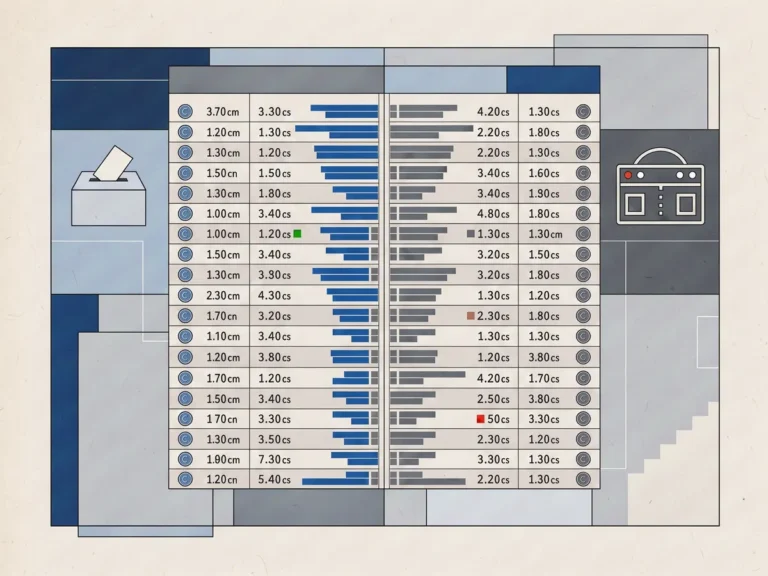
The specific friction Furnace is attacking is that competing venues list contracts that look identical and resolve differently. The company’s own illustration: one venue offers a contract on the Federal Reserve lowering rates before the end of 2026, another on rates being lowered by the end of a given month, a third on rates being lowered with no timeframe attached. Three headlines a skim-reader would call the same market. Three different instruments.
For an institution running positions across venues, that is basis risk sitting inside a position the risk system reports as flat. Buy one side on Venue A, sell what looks like the same side on Venue B, and you are not hedged, you are long a difference in resolution terms that nobody priced. Furnace’s answer is to give the underlying exposure one canonical identity while keeping each venue instrument distinct, with its own terms and resolution details, so a risk engine can see both the similarity and the gap. Retail traders face a smaller version of the same problem and have no vendor solving it for them, which is why reading the resolution criteria rather than the question title is the single most useful habit in this market.
Why venture capital is warming to the plumbing now
Timing comes down to the sector’s push upmarket. Prediction markets are courting institutional participants to broaden utility beyond retail-heavy event and sports derivatives, and institutions do not arrive without the reference data, identifiers and integration layers they take for granted in other markets. Polymarket hiring a former Goldman Sachs partner to steer institutional growth, and Cboe corporate performance contracts heading to Robinhood, point the same direction. Build the on-ramp before the traffic, or the traffic does not come.
The second reason is portfolio logic rather than conviction about any one venue. Backing infrastructure means you do not have to pick which consumer platform survives a regulatory decision, a liquidity crunch or a better-funded competitor. It is the picks-and-shovels trade, familiar to anyone who watched capital flow into sportsbook suppliers rather than brands. The pattern is also visible from the other side, as crypto firms file to enter US prediction markets and need somewhere to plug in.
Regulation is the third factor, and the honest version is that it cuts both ways. Event contracts in the US sit under CFTC jurisdiction and their status has been contested, with the boundary between a federally regulated derivative and state-regulated betting still being argued. Clearer rules would expand the market. They could also narrow which products survive. Infrastructure vendors are less exposed to that outcome than venues are, though “less exposed” is not “unexposed”, since a vendor with no customers has no business.
What stronger infrastructure does to the barrier to entry
Cheap, reliable plumbing lets a new event contract platform launch without building reference data, matching and compliance tooling from scratch. That is the sportsbook story repeated: once white-label platforms, odds feeds and payment integrations became purchasable, launching a brand stopped being an engineering problem and became a marketing and licensing problem. Expect the same compression here, with the same consequence, which is more entrants competing on distribution and pricing rather than on technology. B2B suppliers in gambling already behave this way, down to competing on sportsbook tech branding rather than raw capability.
For an iGaming-literate reader, the layers map onto familiar sportsbook functions almost one to one.
| Sportsbook function | Prediction market equivalent | Job it does |
|---|---|---|
| Odds compilation and trading | Market definition and resolution terms | Turns an uncertain event into a priced, settleable instrument |
| Sports data suppliers | Oracle and resolution data feeds | Delivers the outcome that triggers settlement |
| Risk and liability management | Order book matching and market making | Keeps two-sided prices available at usable size |
| Payment service providers | Settlement rails and clearing | Moves funds in, out and across the winning side |
| Player account management and KYC | KYC/AML and geofencing tooling | Verifies users and enforces jurisdictional limits |
What the money has not proved yet
A $3.5 million seed round buys runway, not validation. Furnace has emerged from stealth with named backers and a clearly articulated problem, and that is all the public record supports. Whether institutions adopt a third-party reference layer rather than building mapping in house, whether venues cooperate on data access, and whether the covered-venue list grows fast enough to be useful are all open, and none of them can be answered from a funding announcement.
The broader caution is the one the sector’s own history should teach. Funding momentum in gambling-adjacent tech has repeatedly run ahead of durable demand, and infrastructure vendors in a category this young are unproven at scale by definition. Prediction market startups raising at the infra layer are making a bet that institutional participation in event contracts becomes routine rather than experimental. If it does, the plumbing is worth owning. If the regulatory perimeter tightens instead, the reference layer for a market that stayed small is a smaller business than anyone is currently modelling. Watch the venue integrations and the institutional volume, not the next round.
About The Author