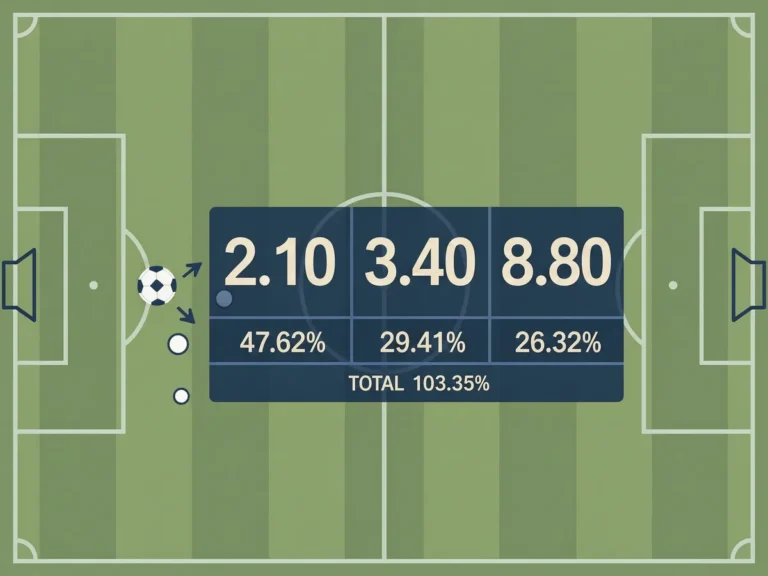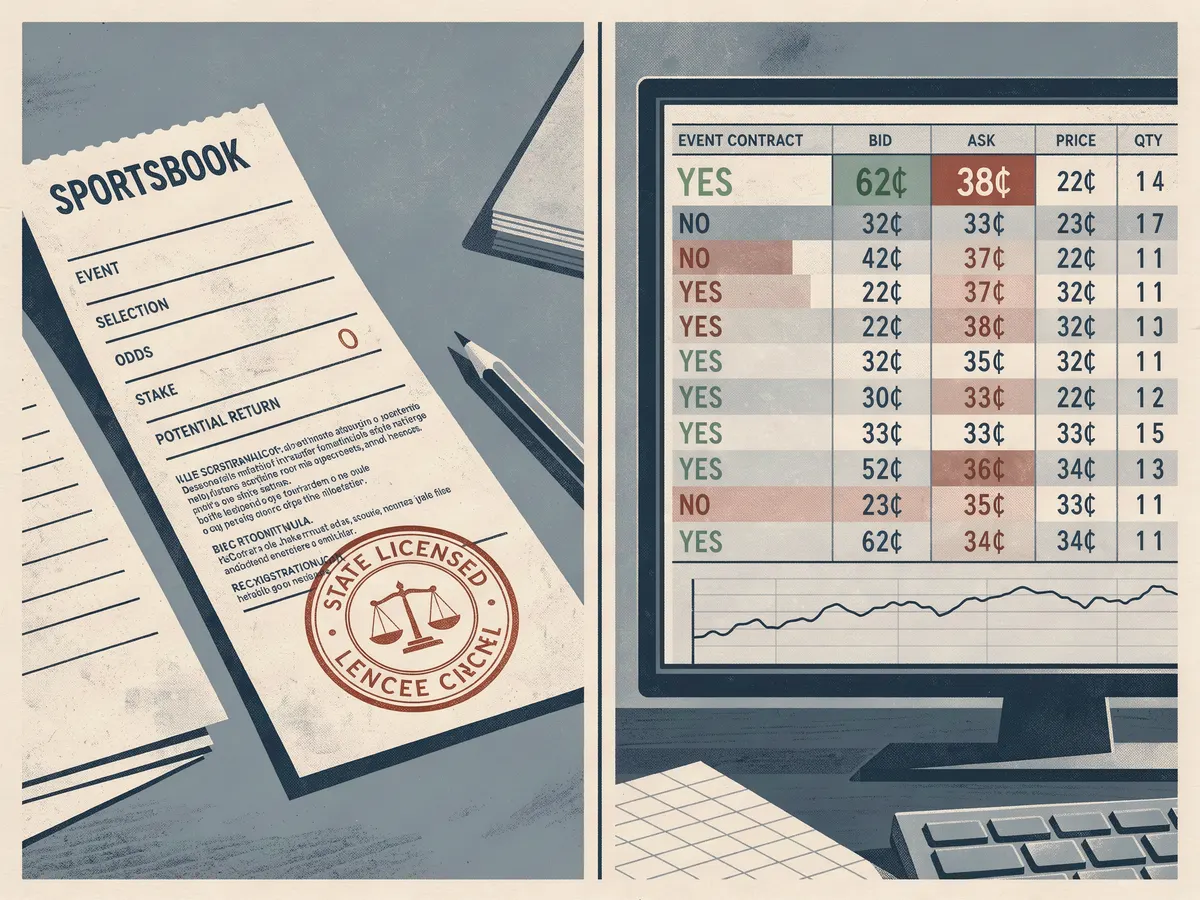
The same draft pick, two different rulebooks
A wager on where a player gets drafted is a licensed sports bet on one platform and an exchange-traded event contract on another, and prediction market regulation is the reason only the first one lands on a state gaming regulator’s desk. Kalshi customers traded 598,464 contracts on Jeremiyah Love going third in the 2026 NFL draft, more than on any other player in that market, according to Kalshi’s public market data as reported by Gambling Insider. Arizona and Massachusetts regulators are reviewing draft betting at the sportsbooks they license. Neither licenses Kalshi.
Here is where most people get it wrong. They read that split as “sportsbooks are regulated, prediction markets are not,” and that is not what is happening. Kalshi is federally regulated, closely and formally, by the Commodity Futures Trading Commission. The difference is not the presence of a regulator but what that regulator was built to police. One agency is designed around sporting integrity and problem gambling. The other is designed around market integrity and settlement risk. If you assume the protections you get at a licensed sportsbook travel with you onto an exchange, you will find out otherwise at the worst possible moment, which is usually a disputed settlement or a frozen withdrawal.
What actually happened with Kalshi’s draft contracts
Kalshi and Polymarket both listed markets on the 2026 NFL draft, and the Love market drew unusually concentrated activity. Nearly three-quarters of those 598,464 contracts traded on 23 April, the night the Arizona Cardinals took Love with the third pick. That is the detail that made the volume newsworthy rather than the raw number.
The reason it drew attention at all is the parallel case at the sportsbooks. Gaming regulators in Arizona and Massachusetts are examining wagering placed through licensed operators in connection with Ryan Gold, the suspended Cardinals scouting director whom the NFL has accused of sharing the team’s draft plans. State regulators can do that because those operators hold licences that come with reporting obligations and audit rights. As Gambling Insider reported, no regulator has publicly confirmed an examination of prediction market trading on the draft.
Worth being precise about what that does and does not mean: nobody has alleged that prediction market traders did anything improper. The point is narrower and more structural. The venue where most of the money moved is the one venue where no gaming regulator has an obvious seat at the table.
How sportsbook draft bets get licensed and watched
Licensed sportsbooks answer to a gaming commission or board in every single state where they take bets, under statutes those states wrote after the Supreme Court struck down PASPA in 2018. There is no national sports betting licence. An operator live in a dozen states holds a dozen approvals, files with a dozen agencies, and follows a dozen slightly different rulebooks on what it may offer, how it must verify customers, and what it has to report.
Why draft props trip integrity alarms
Draft outcomes are decided by a small number of people who know the answer before the market does. That is the whole problem in one sentence. A game result depends on dozens of players in real time; a third overall pick depends on a front office that has usually settled on its decision days earlier. The pool of people with genuine inside knowledge is small, identifiable, and not subject to league betting rules in the same way players are.
So states treat these markets cautiously. Wager catalogues differ by jurisdiction, and a draft market an operator can offer in one state may not be approved in another. Licensed books also sit inside integrity monitoring arrangements, which means unusual betting patterns get flagged, shared, and escalated. Those same obligations are what let Arizona and Massachusetts start asking questions in the first place. The machinery already exists, and it only reaches licensed operators. For the wider policy fight over this, see our explainer on sports betting integrity legislation and the Fair Play Enforcement Act.
How the CFTC ended up overseeing football outcomes
Kalshi operates as a designated contract market under the Commodity Exchange Act, the same federal framework that governs futures exchanges. Under that framework, an exchange can self-certify new contracts with the CFTC rather than seek individual approval from fifty state agencies, and the contracts it lists are treated as financial instruments traded on a regulated exchange, not as bets accepted by a bookmaker.
The distinction is not cosmetic. On a sportsbook, you bet against the house, and the house sets the price and carries the risk. On an exchange, you buy a contract from another trader at a price the order book produced, and the exchange takes no position. That mechanical difference is the foundation of the whole legal argument.
Why a federal wrapper can crowd out state gambling law
Kalshi’s position is that the Commodity Exchange Act gives the CFTC exclusive jurisdiction over contracts listed on a designated contract market, so state gaming law has nothing to attach to. Several state regulators disagree and have issued cease-and-desist orders; Kalshi has contested them in court, and the litigation is ongoing rather than settled. The Act does contain a provision letting the CFTC review event contracts tied to gaming or to activity that is unlawful under state law, which is exactly the hook state regulators point to. How far that provision reaches is one of the questions still being argued. Tribal and state regulators have mounted their own challenge, which we cover in detail in our piece on why tribal and state gaming regulators are pushing back on prediction markets.
Sportsbooks and prediction markets side by side
The comparison below sets out where the two models actually diverge. It describes the regulatory structure, not the quality of either platform.
| Feature | Licensed sportsbook | Prediction market (Kalshi-style) |
|---|---|---|
| Primary regulator | State gaming commission or board, per state | CFTC, federal |
| Legal basis | State sports wagering statutes passed after PASPA fell in 2018 | Commodity Exchange Act; designated contract market rules |
| Licensing | Separate licence in every state of operation | Single federal designation covering the exchange |
| How markets get listed | Wager catalogue subject to state approval; varies by jurisdiction | Contracts self-certified to the CFTC, subject to its review |
| Counterparty | The operator takes the other side | Another trader; the exchange matches orders |
| Consumer rules | State-mandated age checks, KYC, responsible-gambling tools, dispute escalation to the regulator | Federal customer-protection and market-conduct rules written for traders |
| Geography | Only in states that have legalised and licensed sports betting | Offered nationwide under the federal designation, subject to ongoing litigation |
| Draft-style markets | Approved state by state; inside integrity monitoring and league reporting channels | Listed as event contracts with a public order book |
Prediction market regulation tracks the instrument, not the outcome
Regulation attaches to the legal form of the transaction, not to the event being priced, which is why identical predictions about the same draft pick land in two separate regimes. The underlying question is the same for a bettor and a trader. The paperwork is not, and the paperwork is what determines which agency has authority.
Add the structural asymmetry and the gap widens. State gaming law is fifty regimes with narrow, deep powers over the licensees inside each border. Commodity law is one regime with broad reach over exchanges and no mandate to think about sporting integrity as such. A draft market sitting on a federal exchange is therefore visible to a regulator that is not looking for insider knowledge of draft plans, and invisible to the regulators that are.
There is a real trade-off here, and I do not think either side has a clean answer. Exchanges publish order books and settlement data, so the raw record of who traded what and when is more transparent than a sportsbook’s internal ledger, which is only disclosed when a regulator demands it. But transparency is useless without someone whose job is to read it in search of manipulation. Licensed books have watchers with a narrow view; exchanges have a wide-open view with no gaming watcher assigned. Which structure catches an insider faster is genuinely untested.
What you give up, and what you gain, on an exchange
The practical difference for you is the escalation path and the mandated player-protection tooling, not the fairness of the price. If a licensed sportsbook voids your bet or sits on a withdrawal, there is a state gaming regulator with jurisdiction over that operator and a complaints process you can use. On a federally regulated exchange, your recourse runs through the exchange’s own rules and the CFTC, a route built for trading disputes rather than gambling disputes.
State licensing also mandates specific tools: verified age checks, deposit and loss limits, time-outs, and self-exclusion programmes you can enrol in across licensed operators. Those requirements come from gaming statutes. They do not automatically exist on an exchange, because an exchange is not regulated as a gambling venue. If you use self-exclusion as a control, check whether it even exists on the platform in front of you before you fund an account, and read our guide to how self-exclusion rules differ between platforms if you rely on it.
What you gain is access. The federal designation is why these markets have been reachable from states that never legalised sports betting at all, and why a single account reaches a national order book. That is a genuine benefit. It is also the exact thing state regulators object to, so do not treat it as a settled feature.
What is still open
Nothing about this is resolved, and anyone telling you how it ends is guessing. State cease-and-desist actions are in litigation, the CFTC’s authority over sports-linked event contracts is being argued rather than clarified, and Congress has not legislated the boundary. The Arizona and Massachusetts reviews may produce findings about licensed sportsbook activity around the draft; whether any body examines the exchange side is, as of the reporting on the Love market, unconfirmed.
So the useful posture is to treat the platform’s regime as a fact about your own exposure. Before you place a draft wager anywhere, know which regulator has authority over the venue, what happens when you dispute a settlement, and whether the controls you depend on are actually there. If gambling has stopped feeling optional for you, the tools that help are the ones state licensing mandates, and the national helpline in your jurisdiction does not care which wrapper your bet came in.
About The Author