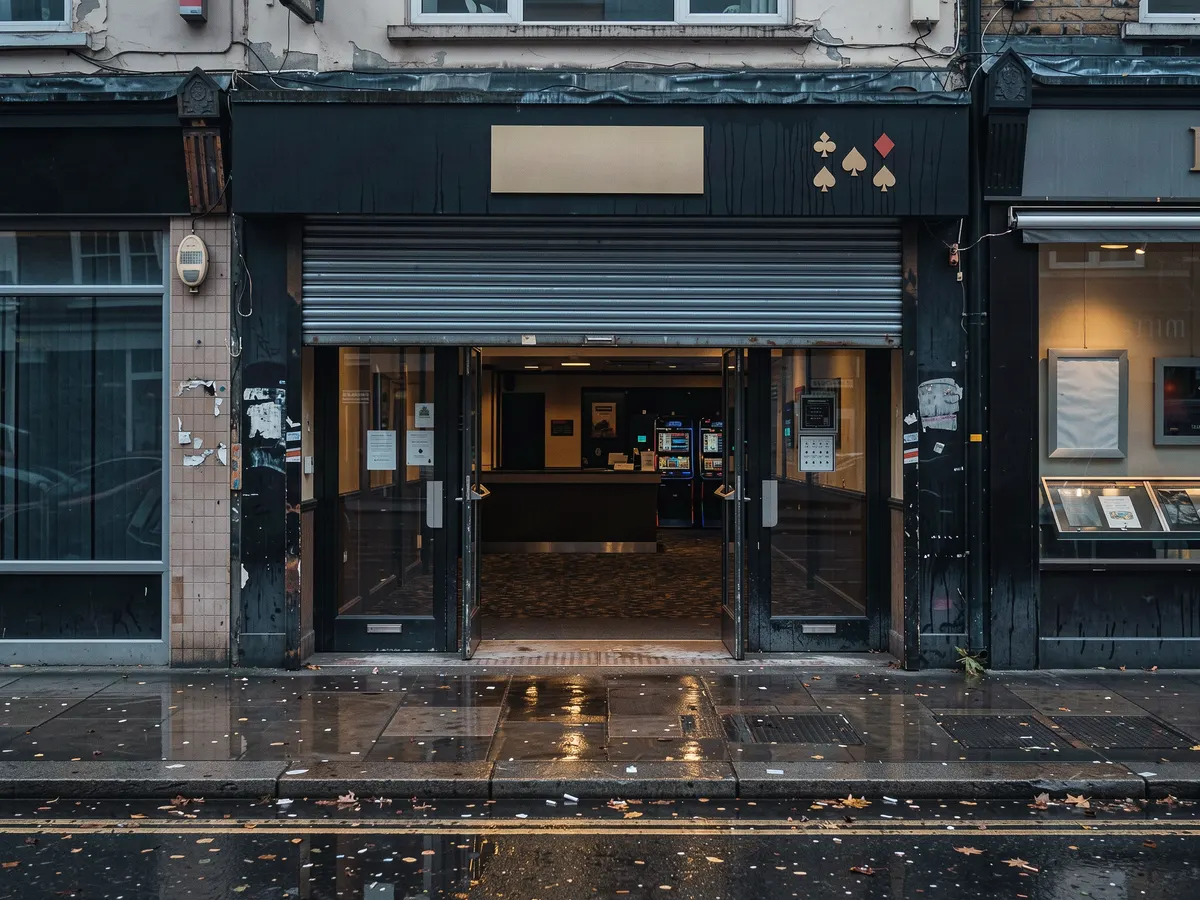
Three casinos closed in a single quarter at a company whose revenue was simultaneously growing. That is the detail worth sitting with in Rank Group’s latest trading update: group revenue up five per cent to £216.1m, land-based up five per cent, online gaming up six per cent, and venues in Swansea, Reading Central and Sunderland closed anyway. It is the cleanest live illustration available of the gambling tax impact on casinos, because it separates two things people usually conflate. A casino can be busy and still be unviable. What decides which is true is the cost structure underneath it, and tax sits near the top of that structure.
Three closures in one quarter, and a warning about the next ones
Rank Group, which operates the Grosvenor Casinos and Mecca bingo brands, closed three venues during the quarter and has warned that a proposed increase to Machine Games Duty would lead to further closures. Chief Executive Richard Harris said that any increase to MGD “will increase costs, reduce venue viability, lead to venue closures and job losses, reduce tax receipts and halt investment,” adding that speculation around the upcoming Budget continues to weigh on investor sentiment. He also noted that HM Treasury recognised these economic arguments last year, and that with the right conditions the company believes its casinos and bingo clubs can contribute to the Government’s growth agenda.
Everything in that paragraph comes from the company and the trade report of its results. It is an operator making a case ahead of a fiscal event, which is exactly what operators do before Budgets. That does not make the argument wrong. It does mean the mechanism behind it deserves examining on its own terms rather than being taken on trust.
Machine Games Duty, explained without the jargon
Machine Games Duty is a UK tax charged on the net takings of gaming machines: the money players put in, minus the money paid back out as winnings. The operator holding the relevant licence accounts for it to HMRC, and it is charged in bands, with machines offering higher stakes and prizes taxed at a higher rate than low-stake machines. It replaced the older amusement machine licence duty and VAT treatment of machine play, consolidating machine taxation into one duty. Current rates and band thresholds are published by HMRC and should be checked there rather than assumed.
The crucial word in that definition is takings, not profit. MGD is levied before rent, before wages, before energy bills, before the cost of the machines themselves. A venue that is losing money still pays it. A venue making a thin margin pays it at the same rate as one making a fat one. That is unremarkable as tax design, and it is also precisely why a percentage-point change lands harder than its size suggests.
How MGD differs from the other duties a casino pays
A British casino does not pay one gambling tax, it pays several, each attached to a different part of the floor. Table games and other casino gaming fall under gaming duty, charged on gross gaming yield in bands that rise with the size of that yield. Betting and bingo have their own duties. MGD covers the machines. The practical consequence is that a change to any single duty reshapes the economics of one revenue line while leaving the others alone, which pushes operators to think about their floor space in tax-adjusted terms rather than purely in player-demand terms.
Why machine takings carry so much of the floor
Gaming machines are usually the steadiest and most labour-efficient revenue line in a land-based casino. A machine bank does not need a dealer per unit, does not need a pit boss, and does not go quiet because a table failed to fill. Tables need staff on shift whether four seats are occupied or none, and the staffing cost arrives whether or not the players do.
That makes machine net takings the part of the business most likely to be covering the fixed overhead of the building. Casino operating margins in the land-based sector are typically slim once rent, business rates, staffing and compliance are paid, so the revenue line with the least variable cost attached tends to be the one holding the venue above water. Tax the net takings on that line more heavily and you are not shaving a little off a broad profit pool. You are reducing the contribution of the component that funds the rest.
How a tax line turns into a shuttered building
The chain from a Budget line to a closed door is shorter and less dramatic than it sounds. It runs roughly like this:
- Duty rises on machine net takings, so every pound the machines hold produces fewer pence of contribution to the venue.
- The operator cannot pass the cost through cleanly. Game margins are set by the games themselves, and raising prices in a competitive leisure market risks pushing visits elsewhere, including online.
- The gap has to be absorbed somewhere: fewer staff, fewer machines, deferred refurbishment, reduced opening hours.
- Venues already near break-even cross into sustained loss, and the question changes from how to improve them to whether the lease is worth renewing.
- Capital that might have refurbished a marginal site is redirected to stronger sites, or withheld while the policy picture is unclear, which is the “halt investment” part of Rank’s warning.
Nothing in this chain requires a tax rise to be large. It requires the venue to have been marginal already, which many high street casinos are, for reasons that have little to do with duty: footfall patterns, city-centre rents, the cost of running a large late-night building, and the long migration of casual play to phones.
Why some venues close before others
Closures cluster at the bottom of the estate. A tax change is uniform across sites, but its effect is not, because every venue enters the change from a different position. The ones that go first tend to share a profile: high fixed property cost, a catchment that has thinned, a building too large for current demand, a lease decision due. Rank’s own disclosure is instructive here, since one of the closed venues had been publicly flagged as loss-making before the decision was taken. The duty is better understood as the thing that removes the remaining margin for error than as the sole cause. Treating it as the only driver overstates the case, and the companies making the argument are, in fairness, usually careful to say “viability” rather than “cause”.
What leaves the high street along with the building
Three closures mean three sets of jobs: dealers, cashiers, security, hospitality and management, in roles that are often difficult to replace locally with comparable hours and pay. Casino job losses rarely come with a transfer option, because the nearest remaining site may be an hour away or may not have vacancies.
For players, the loss is one of access, and it is worth being precise about what access means. A licensed venue is a supervised environment: staffed floors, published rules, identity checks, on-site responsible gambling tools, and a regulator with the power to act on complaints. When it closes, the demand does not vanish with the lease. Some of it moves to another licensed venue, some moves online, and operators argue some risks drifting towards channels with weaker safeguards. The direction of that drift is genuinely difficult to measure, and anyone claiming a precise figure for it is guessing. If you gamble, the tools that matter most are the ones you set yourself, deposit and loss limits, time-outs, self-exclusion, and those travel with you across operators in a way that a local venue cannot.
Is this a pattern, or one company’s quarter?
Taxation pressure on the land-based casino industry is a recurring theme rather than a one-off, for a structural reason: duties are charged on takings or yield, while the heaviest costs of a physical venue are fixed. Any operator with buildings is more exposed to a turnover-based tax than an operator without them, which is why the land-based and online halves of the same company can react so differently to the same fiscal change. Rank’s own numbers show both lines growing while three buildings closed.
Beyond that structural point, caution is warranted. It would be easy to reach for other markets and other closures as supporting evidence, but the source for this story covers one operator, one duty and one quarter, and any additional case needs verifying against its own filings before it belongs in the argument. Land-based casinos also face pressures that have nothing to do with duty at all, and ownership questions can decide a venue’s fate just as firmly as tax does, as the case of MGM’s blocked Springfield casino sale showed from a completely different direction.
What operators want from the Budget, and why the gambling tax impact on casinos stays contested
The ask is straightforward: no further increase to Machine Games Duty. The argument attached to it is the one Rank’s chief executive set out, that higher duty raises costs, reduces venue viability, triggers closures and job losses, suppresses investment, and ultimately reduces the tax the Treasury collects from the sector.
That final claim is the unresolved part, and it is unresolved because it cannot be settled in advance. Raising the rate collects more per pound of machine net takings. Closing venues shrinks the number of pounds there are to tax, along with the employment taxes and business rates those buildings generated. Which effect dominates depends on how many sites are genuinely marginal, how much play relocates to other licensed venues rather than disappearing, and how operators reallocate capital afterwards. Nobody outside Treasury modelling and operator forecasts can answer that, and the two sets of numbers are built on different assumptions by parties with different interests. What is observable is narrower, and still worth holding onto: a growing company closed three casinos in a quarter and named the duty as the reason more could follow. The next Budget will determine whether that was a forecast or a negotiating position.
About The Author



2 thoughts on “How Rising Gambling Taxes Can Force Casinos to Shut Their Doors”