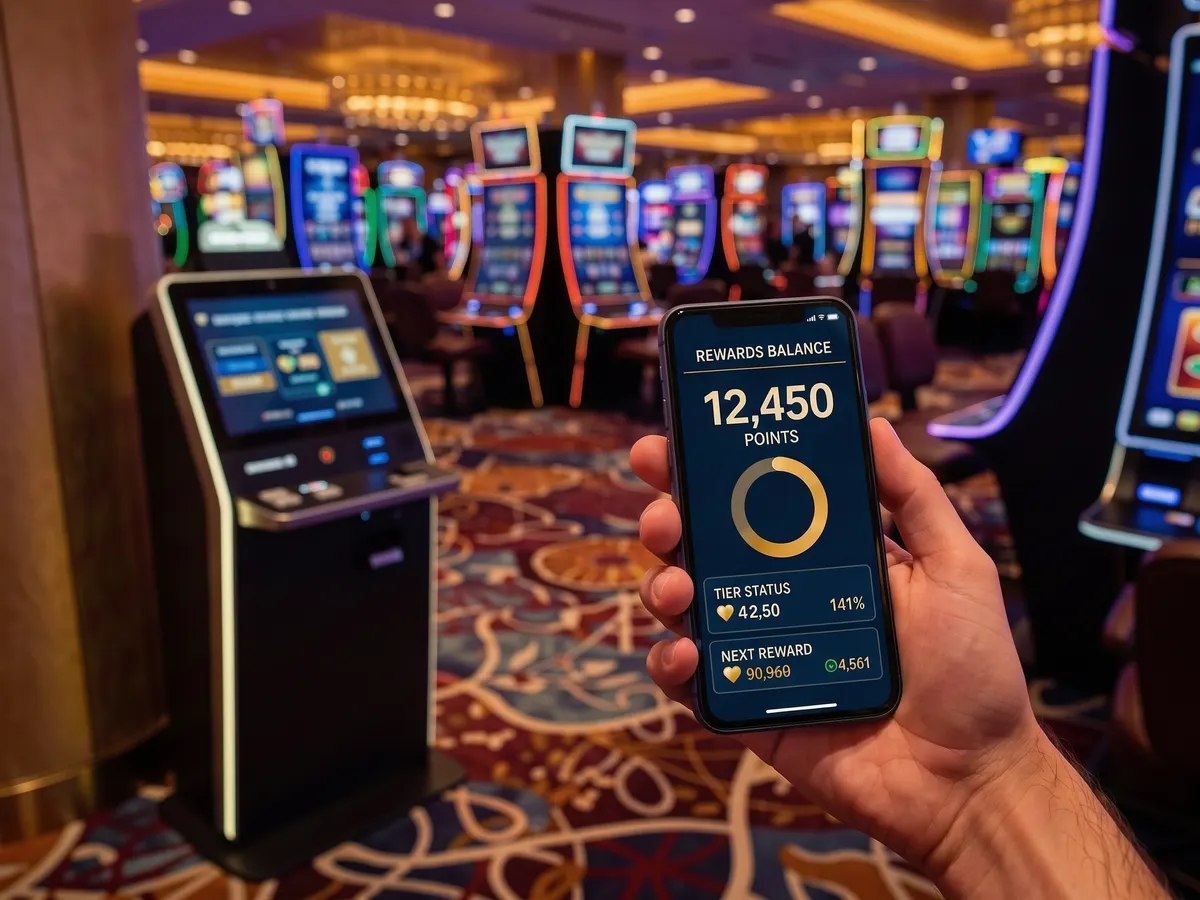
A casino loyalty kiosk is a self-service terminal where a player checks their points balance, claims an offer and enters a drawing. That definition held for most of three decades, and it is now the thing the vendors are actively trying to escape. Randy Gilbert, CEO and CFO of Table Trac, Inc., the company behind CasinoTrac, put it bluntly in a recent trade interview: “KioskTrac is no longer just about being a kiosk.”
Which sounds like marketing until you look at what has to be true for the sentence to mean anything. Moving loyalty off the box in the corner of the floor is not an interface project. It is an accounting project.
The problem with a kiosk is that players have to walk to it
Every engagement a static kiosk produces is gated by a player deciding to stop playing and queue. That is the whole constraint. A player who is mid-session at a machine, or eating, or still in the parking lot, is unreachable by a device bolted to a wall, no matter how good the offer sitting in it happens to be.
The result is familiar to anyone who has worked a promotions calendar: a spike of redemptions at 7pm before a drawing, a queue, and a long tail of offers that expire untouched because nobody felt like standing in line for them. Unclaimed offers are not neutral. They are marketing spend that was budgeted, accrued and never converted into a visit.
KioskTrac launched in 1997, a year short of three decades ago, as exactly that kind of destination device. Gilbert describes the starting point as “a way for players to check balances and access offers.” The function was transactional, the location was fixed, and the engagement began and ended at the terminal.
Why loyalty got stuck at the terminal
The cause was architectural, not a lack of imagination. A kiosk could only hand out what the player management system could authorise at that terminal, in that moment, against that account. Point balances lived in one system, promotional credits in another, the slot floor in a third, food and beverage in a fourth. Every hand-off between them was a reconciliation problem, so the simplest safe design was to keep the transaction inside one physical box where it could be tracked.
That is why so many properties ended up with loyalty programmes that are rich in data and poor in reach. The casino knows exactly what a player did. It just has no way to act on it until the player comes back and queues.
What CasinoTrac has actually bolted together
KioskTrac now runs as a connected layer across four things: the CasinoTrac player management system, PlayerLINQ, the KTMobile app, and the gaming devices themselves. Gilbert’s framing is that the platform “provides a connected engagement experience that spans kiosks, gaming devices, loyalty programs, and mobile technology.” The kiosk is still there. It is no longer the only door.
KTMobile is the part that changes the reach problem. It is a customised mobile rewards app that puts the kiosk’s functions on the player’s own phone, with touchless transactions, so promotions, rewards and loyalty features are reachable on and off property. Gilbert’s phrasing is that it turns KioskTrac “from a destination on the casino floor into an ongoing relationship with the player.” For operators, the claim is more contact points and less friction. For players, it is not having to queue.
The less glamorous and more consequential piece sits underneath: CasinoTrac’s patented digital currency transfer solution. Promotional credits and cash credits move from the player’s account to slot machines, table games, restaurants and other points of sale through a digital player card. That is the accounting problem being solved. Without it, a mobile app is a nicer-looking balance screen.
| Capability | Kiosk era | Connected platform |
|---|---|---|
| Where engagement happens | At the terminal, in person | Kiosk, gaming device, phone, on or off property |
| Core function | Check balance, claim offer, enter drawing | Promotions, rewards, contests, drawings, premium games, targeted marketing |
| Funds movement | Printed voucher or credit at the kiosk | Digital player card to slots, tables and food and beverage |
| Timing of contact | When the player chooses to queue | When the operator chooses to reach out |
Where the “just go mobile” advice stops working
The standard advice to land-based operators is to retire the kiosks and push everything into an app, and I think that is the wrong call. The kiosk is not the bottleneck; the single point of contact is. A property that rips out terminals and replaces them with a download prompt has swapped one narrow door for another, and the new one requires the player to have storage space, a current OS and a reason to care.
Kiosks still do things phones do badly. They verify a physical presence on the floor. They serve the player who will not install anything. They handle the enrolment moment, which is where the whole relationship starts. CasinoTrac’s own positioning keeps them in the stack rather than sunsetting them, and that is the honest read of the technology: mobile extends the kiosk, it does not replace it.
The second place the advice breaks is measurement. A loyalty app that gets installed and never opened is a cost, not an asset. Downloads and registrations are the metrics that get presented at board level, and they tell you nothing. The numbers worth watching are offer redemption rate, the share of promotional credit that actually reaches a point of sale, and whether off-property messages produce a visit rather than an uninstall. None of those figures have been published for this platform, and I would not assume them from a vendor interview. CasinoTrac says its G2E 2026 showcase demonstrated expanded promotional capability across the player journey; a demo is an argument, not evidence.
What the iGaming side should take from it
Online operators solved the reach problem years ago, and are now watching the land-based floor adopt their model. Account-based identity, server-side bonus crediting, push notifications tied to behaviour, a single wallet that funds every product: that is an online casino’s standard architecture, arriving on a slot floor. The convergence runs both ways. A player who holds one account, one card and one app across a property and its online brand is a single loyalty record, and that record is worth more to a marketing team than two partial ones.
The flip side deserves naming. Frictionless movement of promotional and cash credit from a phone to a machine removes the small pauses that used to function as a brake: the walk, the queue, the printed voucher. Cashless convenience is a genuine improvement for most players and a genuine risk for a minority, which is why deposit and loss limits, session reminders and self-exclusion have to live inside the same app as the offers, not three menus away. Any operator deploying this should treat the limit tooling as part of the launch, not a later release.
The open question is simpler than the technology. Players did not ask for another app. Whether they keep one on their phone depends entirely on whether the offers inside it are worth the notification, and nobody has shown that number yet. The CasinoTrac interview was published by CDC Gaming.
About The Author


3 thoughts on “Inside the New Wave of Casino Loyalty Kiosks That Follow Players Anywhere”